Equity derivative volumes on BSE slide to 4-year lows
Average volumes for December stood at Rs 5,400 crore
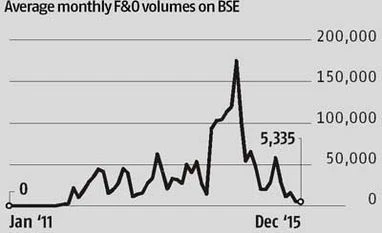
Ashley Coutinho Mumbai Equity derivative volumes on the BSE have slid to four-year lows owing to the recent increase in the derivatives contract size and the exchange’s decision to gradually trim its incentive structure for market makers.
The average volumes for December stood at Rs 5,400 crore, the lowest since January 2012.
“It was mostly the proprietary brokers who had been trading on the BSE derivatives platform with a view to earning incentives. As the incentive has reduced, so has the participation from these brokers,” said a broker, on condition of anonymity.
According to him, the exchange has been reducing its incentives for the past one-and-a-half years. Fifteen to 20 per cent of the derivatives volumes on the National Stock Exchange (NSE) are contributed by proprietary traders, another 40 per cent by retail participants, and the rest by institutional investors. On the BSE, close to 100 per cent of volumes are contributed by the proprietary traders.
“Liquidity chases liquidity and most investors now believe there is no real reason to trade on another exchange,” said Nithin Kamath, chief executive of Zerodha, a discount broker.
“After sustained effort at increasing liquidity, we realised the open interest did not go up much, though volumes and turnover did increase. In this context, it was decided to slowly taper the LEIPS (liquidity enhancement incentive programmes) and focus on building volumes by putting in sales efforts with trading members and buy side customers to get more market share,” said BSE in an emailed response. “We have achieved significant liquidity and market share in the currency and IRF (interest rate futures) segments and will continue similar efforts in the equity derivatives segment as well.”
Interestingly, the futures and options (F&O) turnover on the BSE had surpassed that of NSE for the first time ever on June 24 last year. Between June and December 2015, the exchange’s average monthly F&O turnover stood at a healthy Rs 1 lakh crore mark.
The increase in the minimum contract size for trading in equity derivatives from Rs 2 lakh to Rs 5 lakh from November 1 has also adversely impacted derivatives volumes on the bourses. This is true for both the exchanges, but its impact has been more pronounced in the case of BSE, said experts.
For instance, the average volumes in the F&O segment on the NSE has dipped 15-23 per cent in the past two months over average volumes till October. On BSE, the dip has been about 80 per cent.
The increase in contract size has jacked up costs, resulting in some money moving from the derivatives segment to the cash market. “The past two months have seen action in mid- and small-cap stocks in the cash segment, resulting in money moving out from the large cap derivative segment,” said a senior broker.
The BSE had launched a series of LEIPS to create self-sustaining liquidity in its F&O segment in September 2011. This was after the Securities and Exchange Board of India allowed stock exchanges to introduce liquidity enhancement schemes for illiquid securities in equity derivatives segment in June 2011.
The exchange has been regularly amending the terms and conditions of its LEIPS programmes based on the overall progress of the programme, market feedback and policy changes.

 "Equity derivative volumes on BSE slide to 4-year lows")


 Connect with us on WhatsApp