After seven painful quarters, the cement industry seems headed for a strong show. The combined profitability, as represented by Ebitda (earnings before interest, taxes, depreciation and amortisation), of the top 20 companies in the sector grew a little over 40 per cent in the September quarter.
Volume growth has also been healthy. The low base of the year-ago quarter, when Ebitda fell nearly 45 per cent, can be part reason for this spurt. Even so, there are signs of better days ahead. For instance, while volumes are picking up, Ebitda per tonne declined marginally on a sequential basis, say analysts. This is comforting, they say, given the seasonality factor - July to September is weak due to the monsoon.
Volume growth, close to 10 per cent in the first half of 2014-15 for the top 20 companies in the sector, is expected to remain in high single-digits in the second half. Even thereafter, it is seen around 10 per cent, supported by higher demand induced by rate cuts, economic growth, higher government spending and the like.
With companies also able to sustain a reasonable amount in price increases, including the South India-based companies which have been facing a tough time due to over-supply, the top line growth is expected to be close to 15 per cent in the coming quarters. Though some price correction in October-November was understandable after the substantial rises in June, especially in South India where the 50-kg bag price was raised by as much as Rs 100, companies have again raised prices this month, by Rs 5-15 a bag.
If that isn't enough, the Gods seem to be also favouring cement companies with softer commodity prices. In the past year, global coal prices have declined from Rs 5,000 a tonne to about Rs 4,000. Coking coal prices have fallen similarly. The recent decline in crude oil prices, leading to a significant cut in diesel prices, can reduce the transportation costs of companies. Even petcoke prices, after surging in the June quarter, have softened and are likely to remain so, with lower crude oil prices. With China, Japan, Europe and many more economies witnessing slowing growth, expect commodity prices to remain under pressure or at least range-bound, buoying the margins of cement companies.
Higher volumes, better realisations and lower costs are partly reflecting in the profitability. Rajesh Kumar Ravi of Karvy Stock Broking says in a November 24 report, "The dual benefits of lower freight costs for finished as well as raw material should be seen in subsequent quarters, thereby further boosting Ebitda margins. Overall, we expect industry Ebitda to grow at a 45 per cent compounded annual rate over the next three quarters."
Profitability is also likely to be better, as some impact of high-cost petcoke inventory had led to lower than expected Ebitda per tonne in the September quarter. The benefits of lower petcoke prices will be felt now.
While there is optimism on demand growth, the capacity expansions have slowed, compared to the past five years. Cement equipment suppliers have seen only three-four major orders placed in calendar year (CY) 2014, of eight to 10 million tones (mt), significantly less than the annual ordering of around 25 mt seen in CY06-CY08. Thus, after 146 mt of capacity additions from FY10-14, the pace is to come down to only 41 mt expansion over the next three years, says an analyst at Spark Capital. This will bring a balance between demand and supply. India's cement industry is seeing around 69 per cent capacity utilisation (CY14), expected to improve to 77 per cent by CY18, says a Credit Suisse report, referring to Holcim's presentation.
The demand-supply imbalance is South India, however, remains a cause of concern. Investment on new infrastructure by the new states (Telangana and Seemandhra) will be critical to bring back balance. Analysts at Dolat Capital believe this can lead to the return of volumes to those seen at the peak in pre-split Andhra (18 mt in financial year 2009; 13.5 mt in FY14).
While stocks are to an extent pricing in a recovery, the key to a further upside is the pace of recovery in demand and how long the upcycle lasts. Analysts at Credit Suisse say cement stocks are already pricing in the start of an upcycle. Whether the length would be two years or five years will drive further upside. They expect demand growth to recover to eight to 10 per cent next year and prefer mid-cap scrips such as those of JK Cement, Dalmia and JK Lakshmi.
Motilal Oswal analysts remain positive on the medium-term growth outlook. And, say near-term growth would be aided by a favourable base, as the volume growth between December 2013 and April 2014 was around 2.8 per cent, year-on-year. They are positive on companies with strong volume levers, efficient operations and a healthy balance sheet (or deleveraging visibility), preferring UltraTech, Dalmia Bharat and JK Cement. Analysts at Sharekhan prefer UltraTech and mid-cap entities such as JK Lakshmi and Mangalam Cement.

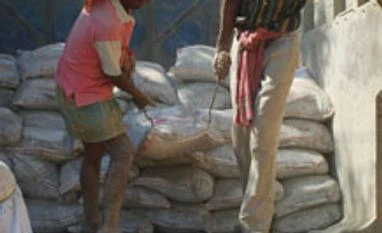 "Good days ahead for cement firms")


 Connect with us on WhatsApp