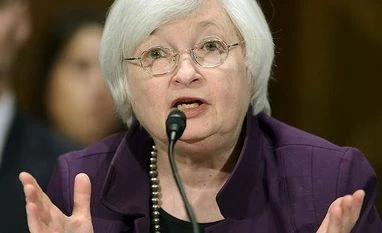
Federal Reserve Chairwoman Janet Yellen has prepared the grounds for a rate hike in US interest rates, the first such hike since the past nine years. Financial markets globally are jittery as many investors anticipate a sell-off, especially in emerging market economies. While it is impossible to predict the future, we can take lessons from how markets behave when similar hikes have taken place in the past.
Before looking at how markets have reacted to interest rate hikes earlier, it is important to know that the present scenario is different from any other earlier hikes. None of the earlier hikes were from a zero level base, which the Fed has maintained since the financial meltdown. Further, while global financial markets have been integrated for the last few decades, US money, thanks to a series of Quantitative Easing (QE) measures, has percolated down across global markets wherever it found positive yields. Thus, the impact of an interest rate hike this time around will be more far reaching than earlier times.
So how did the markets, especially Indian markets, react to earlier fed rate hikes? Since 1983, the US Fed has raised rates six times, the last one being in 2004. For Indian markets, however, the last three – in 1994, 1999 and 2004 – are more relevant since foreign money data has been maintained by Sebi only from 1993 onwards.
The first hike, which could have impacted Indian, markets since 1993 was announced on February 4, 1994. BSE Sensex had rallied by 69% from 2,336 to 3,947 six months prior to the hike. In the next six months, the pace slowed to 8.3% touching levels of 4,276. But importantly FII inflows were positive in the six months following the rate hike.
The second rate hike started just before the dotcom bubble burst as the US government felt its economy was heating up. The Fed started increasing rates from June 30, 1999. Indian markets were warming up to the global rally with some help from participants like Ketan Parekh. From levels of 3060 Sensex touched 4144, a gain of 35% as the US Fed decided to hike rates. Indian markets continued to move higher, taking the rate hike in its stride and touched 5375, a gain of nearly 30% in the next six months.
FII flows were positive for all the six months prior to the hike and saw selling in three months after the hike. The month of July 1999, the very next month after the hike was a positive month for FII flows, but small levels of selling was witnessed in the following three months. The last two months saw good buying interest resulting in a strong positive figure for the six months following the rate hike.
The most recent hike was on June 30, 2004. Indian markets had fallen, thanks to a change in government after the popular Vajpayee government lost the mandate. Markets were trading 18 per cent lower from 5,915 levels at the start of the year to 4,874.
FII flows were negative in the month of May 2004, when election results were announced. Inflows trickled in for the next two months but zoomed higher in the final four months of the year. This resulted in market posting a sharp 28 per cent gain in the six month period following the hike.
As we head in for a likely scenario of a rate hike in mid-December 2015 Sensex is down by nearly 11% in the last six months. FIIs have been net sellers in four of the last six months with the total being a negative figure.
This scenario has not been witnessed in any of the earlier rate hikes as new players like ETFs and Hedge Funds are wary of the uncertain future. History however suggests the following six months of a rate hike are better.

 "How Indian markets react to US Fed's rate hikes: A brief history")


 Connect with us on WhatsApp