Not only mango lovers but exporters, too, are staring at a dull season this year. With production in the major producing states down about 50 per cent, prices in the domestic market are already high. Exports are also likely to be muted.
According to Abhijeet Bhasale, managing director of Pune-based import-export house Rainbow International, also engaged in online retailing of mangoes through mangowale.com, “Production in the major producing states of Maharashtra, Gujarat, Andhra Pradesh and Karnataka are down almost 50 per cent. This would impact availability in the domestic market and also impact exports.”
Distributors and traders say regions Andhra has been hit severely during the Hudhud cyclone in October last year, followed by unseasonal rain at the onset of summer this year. The region is left with 25-30 per cent of its normal production, estimated to be around 200,000 tonnes a year.
Similarly, in Gujarat, which exports the kesar variety, exporters say usually export inquiries start by mid-April. This year, only a handful of exporters have received queries.
“Gujarat has no Agricultural Processed Food Products Export Development Authority (Apeda) approved packaging facility. That is also a drawback,” said Harsukh Zarsaniya, secretary of Talala Agricultural Produce Market Committee (APMC).
Quality is also an issue, allege traders. This year, the weather conditions were not very favourable for the crop between January to April. Unseasonal rain in many growing areas across Gujarat have damaged the mango fruits.
“Quality is not matching the export criteria. However, we are waiting for regular arrivals in the market,” said Sanjay Vekaria, grower and trader from the Gir area of Gujarat.
The Talala APMC is the largest place in Gujarat for auction, especially for the kesar variety. Auction here is expected to start from May 19, late by almost 20 days compared to last year. Traders expect prices of the variety at around Rs 450 per 10-kg box, higher by nearly Rs 150 a box from last year.
Apeda, however, is not panicking. Sudhanshu, its regional in-charge, west, said, “Exports to the European Union have started from March 24. It has been low at around three tonnes a day. However, we are awaiting a new hot water treatment facility at Goregaon, being set up by Apeda, that will be operational within a week. Exports to the EU would pick up after that.”
Hot water treatment is a post harvest requirement to export to the EU. Bhasale alleges despite the EU writing to the government around December, it took time for the final guidelines for exports to come about. “The government issued the guidelines around March, and many exporters are not ready with the preparations,” he said.
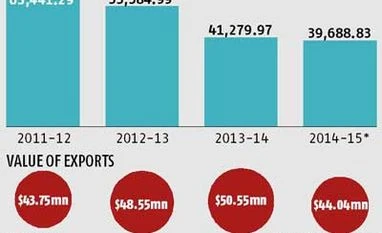
For that matter, mango exports from India have been plunging in recent years. It stood at 41,280 tonne in 2013-14 from 55,585 tonne in 2012-13 and 63,441 tonne in 2011-12. In value terms, the exports rose to $50.55 million in 2013-14 from $48.54 million and $43.73 million in 2012-13 and 2011-12, respectively.
Production of mangoes last year stood at 18.43 million tonne.

 "Infrastructure issues haunt mango exports")


 Connect with us on WhatsApp