IPO investors may get modified safety net
'Stabilising agents' to ensure secondary market price stays above issue price for a certain period
Samie ModakJayshree Pyasi Mumbai To infuse life into the moribund primary market, the Securities and Exchange Board of India (Sebi) is planning to introduce the concept of ‘stabilising agents’ to protect investors and boost participation in initial public offerings (IPOs).
The capital market regulator wants issuers to put in place a price-stabilising mechanism, on the lines of market-making, to ensure the market price of a company doesn’t fall below the IPO price for a stipulated period. Under this mechanism, a company will have to appoint a stabilising agent---a broker or an investment banker. The agent will have to support the secondary market price by transacting in shares through the open market for up to six months.
“Now that the idea of a mandatory safety net has been dropped, we are deliberating whether we can tweak existing provisions under ‘green-shoe’ to protect investors in IPOs. We intend to bring in some of the measures proposed in the safety net to ensure price stability,” said a senior Sebi official.
Currently, the appointment of stabilising agents is compulsory for follow-on public offerings (FPOs) that have the green-shoe option, under which issuers can retain excess subscription of up to 15 per cent of the issue size. ICICI Bank and Tata Steel are among the handful of issuers that have exercised this option in their FPOs.
Though investment bankers aren’t very keen on further obligations, they say the concept of stabilising agents was better than that of a safety net. A safety net, they said, was against the concept of equity investing “Extending the concept of price stabilising agents to IPOs is feasible. It will help the market and provide much-needed confidence to investors for investing in IPOs,” said B Madhuprasad, chairman, Keynote Corporate Services, an investment banking firm.
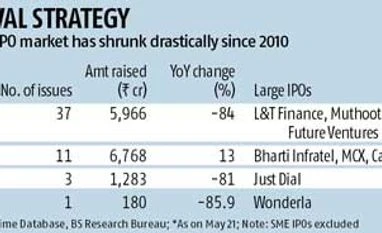
Last year, Sebi had floated a concept paper on safety net, under which retail investors were to be compensated for a fall in share prices after listing. The move was prompted by the wariness of investors towards IPOs, after they lost money in about 80 per cent of the issues between 2011 and 2012. Since then, India’s IPO market has shrunk dramatically.
Sebi is also said to be considering issuing convertible securities to protect investors from down-side risks in IPOs.
Under this mechanism, investors can either earn a fixed coupon or convert the security into equity, depending on the performance of the company’s share price after listing.
“A number of steps are being discussed for IPOs. At the moment, reviving the capital market is one of the top agendas, as the IPO market is crucial for kick-starting the investment cycle,” said a senior finance ministry official.
Sebi is considering mitigating costs for primary-market issuances. Steps planned to cut IPO costs include using secondary market infrastructure for IPO distribution, simplifying application forms and abridging offer documents.

 "IPO investors may get modified safety net")


 Connect with us on WhatsApp