Japanese firms ready to cook up a storm

At present, Japan invests a little over $6 bn in India per annum
graph
graph
Sanjeeb Mukherjee New Delhi
Last Updated : Mar 03 2017 | 1:31 AM IST
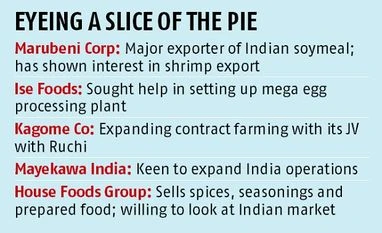
Around 10 major Japanese food processing companies have shown interest in either investing in India or sourcing raw materials from here through contract farming or otherwise.
The names include Ise Foods, Marubeni Corporation, Kagome and House Foods Groups. There is also interest for establishing mega egg processing units and importing high-quality machines for mechanised deboning of chicken.

Officials said the assurance to either invest in India or expand the sourcing came during a meeting between the companies and the Indian government, represented by food processing minister Harsimrat Kaur Badal in Tokyo on Thursday. 

“As compared to Western countries which are more interested in packaging and retailing of food products in India, I found the Japanese were keen on setting up a manufacturing base in India, from where they could meet their demand and also re-export,” she told this newspaper over the phone. 

After the passage of the law on a national goods and services tax here, Japanese companies will have a greater chance to expand their investment in cold-chains and other infrastructure, said the minister. She said the companies in question had adequate funds and technological know-how. 

“The companies were also eager to source lots of fruits and vegetables from India and set up manufacturing bases, which also suits out purpose,” Badal added.

Japan is now the fourth largest investor in India, of a little over $16 billion annually. There was a commitment during the December 2015 visit of Prime Minister Shinzo Abe to invest $33.5 billion in India, doubling of Japanese investment and the number of companies in India, over the coming five years. 

Exports to Japan in 2015-16 were $4.7 billion; imports were $9.8 bn. Bilateral trade is in a narrow range of products, with India’s exports dominated by raw materials and minerals — mineral fuels, mineral oils, marine products, iron and steel, chemicals. Japan’s export to India is dominated by capital and knowledge-intensive manufactured goods — electronic goods, non-electrical machinery and transport equipment, among others.


One subscription. Two world-class reads.

Already subscribed? Log in

Subscribe to read the full story →
*Subscribe to Business Standard digital and get complimentary access to The New York Times

Smart Quarterly

₹900

3 Months

₹300/Month

SAVE 25%

Smart Essential

₹2,700

1 Year

₹225/Month

SAVE 46%
*Complimentary New York Times access for the 2nd year will be given after 12 months

Super Saver

₹3,900

2 Years

₹162/Month

Subscribe

Renews automatically, cancel anytime

Here’s what’s included in our digital subscription plans

Exclusive premium stories online

  • Over 30 premium stories daily, handpicked by our editors

Complimentary Access to The New York Times

  • News, Games, Cooking, Audio, Wirecutter & The Athletic

Business Standard Epaper

  • Digital replica of our daily newspaper — with options to read, save, and share

Curated Newsletters

  • Insights on markets, finance, politics, tech, and more delivered to your inbox

Market Analysis & Investment Insights

  • In-depth market analysis & insights with access to The Smart Investor

Archives

  • Repository of articles and publications dating back to 1997

Ad-free Reading

  • Uninterrupted reading experience with no advertisements

Seamless Access Across All Devices

  • Access Business Standard across devices — mobile, tablet, or PC, via web or app

Next Story



