Markets gain the most since election result
Sensex soars 450 pts; all eyes on RBI's policy review today
BS Reporter Mumbai The markets on Monday posted their best single-day gains since the announcement of the Lok Sabha election result on May 16, mainly on encouraging manufacturing sector data and hopes of capital infusion in the public-sector banks.
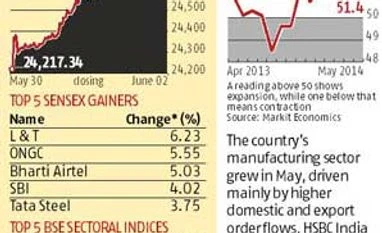
Shares of firms in the banking and capital goods space led the charge, with Larsen & Toubro’s stock surging over six per cent and State Bank of India’s gaining four per cent. Investors were seen buying capital goods shares after a business survey showed the country’s manufacturing sector grew a little in May due to higher order flows. Meanwhile, banking stocks also got a boost on reports the government was planning to inject more capital into state-owned lenders.
Market players said the positive sentiment globally, after the US’ Dow Jones Industrial Average hit new highs, helped Indian shares as well. The BSE Sensex on Monday rose 467.51 points, or 1.93 per cent from its previous close to end the day at 24,684.85. The rise was the biggest since May 12, when the last phase of the general elections was held. The National Stock Exchange’s Nifty, meanwhile, ended 132 points, or 1.83 per cent, higher at 7,362.50, with three of every four of its components gaining. BSE’s captial goods and banking indices outperformed the market, gaining 4.9 per cent and 3.3 per cent, respectively.
“Investors believe this is a good time to put in their money for a medium to long term. The market hasn’t moved much since the election results. So, there is definitely more potential for it to go up,” said Motilal Oswal Financial Services Chairman Motilal Oswal.
Experts said the Street would keenly watch the Reserve Bank of India’s (RBI’s) monetary policy announcement on Tuesday, though the central bank is widely expected to maintain the status quo on policy rates. Some believe the Union Budget, to be announced in July, would be the next big trigger for the market.
“The market is now looking forward to the Budget. So far, we have seen a muted market reaction despite the government taking a lot of steps. However, as the derivative expiry and profit taking are over, we can see fresh positions being taken,” said Ambit Investment Advisors CEO Andrew Holland.
The Indian market has risen nearly 17 per cent so far this year on robust foreign inflows and hopes of economic revival led by the new, stable government. On Monday, foreign investors’ buying so far in 2014 exceeded $8 billion (Rs 50,000 crore). They bought shares worth Rs 234 crore, adding to their Friday’s big purchase of Rs 3,000 crore.
Despite weak macroeconomic fundamentals, overseas investors have been aggressively buying Indian shares on hopes of a turnaround.
Following the sharp rally, the Sensex now trades at a one-year forward price-to-earnings multiple of 15.6 times, above its long-term average of about 14 times. Analysts believe the Indian market deserves to trade above its historical multiples, if the new government pushes ahead with reforms and tackles major macroeconomic challenges well.

 "Markets gain the most since election result")


 Connect with us on WhatsApp