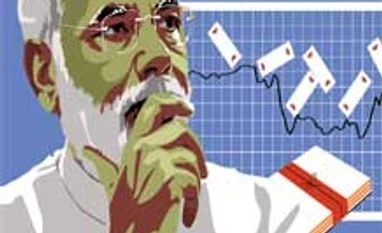
As many as 172 stocks of the 779 counters comprising the BSE S&P Mid-cap, Small-cap and BSE-500 indices have risen by more than 100 per cent — meaning they’ve more than doubled — since September 13, 2013, when the Bharatiya Janata Party named Narendra Modi its prime ministerial candidate.
Of these, 36 have surged more than 200 per cent (four-fold). These include Adani Enterprises, BEML, TVS Motor, KEC International, Sintex Industries, Ceat and Suzlon Energy. The benchmark indices, the S&P BSE Sensex and the National Stock Exchange's CNX Nifty, in comparison, rallied only 26 per cent during the same period.
Backed by hope of a pro-reform and business-friendly government at the Centre, cyclical and policy-oriented sectors attracted heavy buying. Capital goods, banking, power, realty, metal, consumer durables, oil & gas and automobile sector indices rose 30-85 per cent.
Among the broader indices, the S&P BSE Small-cap and S&P BSE Mid-cap indices have gained 62 per cent and 51 per cent, respectively.
“The equity markets have run up over the course of this election, with the Sensex and Nifty hitting lifetime highs. Going ahead, the markets could be supported by sentiment through 2014 and 2015 as investors anticipate a spate of reforms which could lead to an economic re-rating,” suggests Sukumar Rajah, chief investment officer, Franklin Templeton Local Asset Management, Asian Equity.
On the other hand, classic defensive plays such as information technology, fast moving consumer goods and pharmaceuticals have underperformed. Their indices moved up less than 10 per cent during the period.
Investor wealth, measured by market capitalisation, soared by a little over Rs 20 lakh crore to Rs 83.76 lakh crore, on the back of rising stock prices, helped by foreign fund inflows. Data from the Securities and Exchange Board of India shows foreign institutional investors put in a net Rs 93,000 crore ($15.2 billion) in Indian markets since September 2013.
Among the Nifty50 counters, 10 stocks – Larsen and Toubro, Bharat Heavy Electricals, Maruti Suzuki India, State Bank of India, Tata Steel, ICICI Bank, Punjab National Bank, Bharat Petroleum Corporation, Bank of Baroda and Axis Bank rallied by more than 50 per cent during the period.
Analysts say equities still have the most scope for further upside, although a period of consolidation is probably on the cards before any cyclical upswing propels the market higher.
“We think equities still have the most scope for further upside, with the next leg higher, driven by domestic capex-sensitive sectors. Our Asian equity strategists have maintained their overweight stance on India within the Asia-Pacific (ex-Japan) region and have raised their 12-month Nifty target to 8,300 levels,” says Tushar Poddar, chief India economist at Goldman Sachs.
Adds Rajah of Franklin Templeton: “A likely stable Modi-led government, along with a credible central bank headed by Raghuram Rajan, bodes well for India’s medium-term economic prospects, in our view. We see a high likelihood that companies regarded as higher-quality in financial, capital goods, energy and infrastructure sectors could re-rate, following the election.”

 "Modi effect doubles value of 172 stocks")


 Connect with us on WhatsApp