PSU indices wobble on free float rule
Experts see robust appetite for consequent sales over next three years
BS Reporter Mumbai
The capital market regulator’s directive on cutting government shareholding in state-owned companies to no more than 75 per cent over the next three years translates into nearly Rs 60,000 crore of share sales, likely to weigh on some of these companies’ stock performance.
“Some of these stocks have not performed well after the recent stake sales. These will come under selling pressure and could decline three to four per cent more from these levels,” said Ashish Chaturmohta, head, technical & derivatives analysis, Fortune Equity Brokers.
“The price at which the dilution would take place would naturally be lower than whatever will be the current market price at the time. So, investors would want to sell shares now and book profits before the issues are even announced,” said Mehraboon Irani, principal and head (private client group), Nirmal Bang Securities.
On Thursday, the public sector stocks’ index declined by about two per cent after the Securities and Exchange Board of India (Sebi) announced the government holding must be cut from the present cap of 90 per cent to 75 per cent over the next three years. In comparison, the bellwether Sensex was down 0.2 per cent.
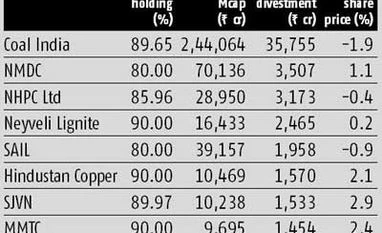
There are currently a little over 30 government companies whose shares are listed for trading on the stock exchanges. These will need to unload Rs 58,547 crore worth of shares in the next three years, according to an analysis by Business Standard.
Coal India would account for the lion’s share, about Rs 36,000 crore. Its share price slid 1.9 per cent to close at Rs 386.40 a share. Next is NMDC, with Rs 3,507 crore. NHPC, Neyveli Lignite, Steel Authority of India (SAIL), Hindustan Copper, SJVN, Central Bank of India and MMTC all have to unload between Rs 1,000 crore and Rs 3,500 crore.
SAIL's scrip fell 3.9 per cent to close at Rs 94.80 a share. State Bank of India was down 1.2 per cent, Oil and Natural Gas Corporation by five per cent and Indian Oil Corporation by 2.6 per cent.
The current buoyancy in the markets would provide sufficient liquidity to absorb the issues, feels G Chokkalingam, managing director, Equinomics Research and Advisory. “Even during the bearish phases of the markets, Qualified Institutional Placements and other secondary market issues were easily absorbed. In the current bullish phase of the market, there will be good appetite for these issues. Beside, the success of the recent QIP issuances could have a rub-off effect on these upcoming stake sales,” he said.
Motilal Oswal, chairman at Motilal Oswal Financial Services, said the longer term outlook for these companies remains robust. “We are likely to see investors' participation in public sector companies and the long-term potential is huge. One should not read too much in today's reaction,” he said.

 "PSU indices wobble on free float rule")


 Connect with us on WhatsApp