Home / Markets / News / Market Update / Risk on, risk off, repeat! US-China trade deal now faces Hong Kong hurdle
Risk on, risk off, repeat! US-China trade deal now faces Hong Kong hurdle
Investors who had sought the safety of government bonds, the yen and gold in early trade shifted back from those positions after China reportedly invited U.S. negotiators for talks.
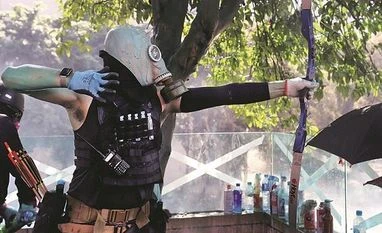
Hong Kong protesters shot arrows and hurled petrol bombs from a barricaded university on Sunday at police | Photo: Reuters
Stocks slid further on Thursday as the standoff between the world's two largest economies expanded beyond trade, reducing the odds of a "phase-one" deal this year and forcing investors to shed risky assets.
Investors had widely hoped for a US-China trade deal by mid-November but the absence of one, and Washington's bill to support protesters in Hong Kong, has brought progress grinding to a halt.
With U.S. President Donald Trump seen as likely to sign the bill, Deutsche Bank strategist Jim Reid said this "could risk progress towards a phase one trade deal".
European shares nevertheless bounced back from day lows in late morning trade as fresh reports emerged that China has invited top U.S. trade negotiators for a new round of face-to-face talks in Beijing.
The trade-sensitive German blue-chip index was down 0.2%, recovering from a 0.7% fall, after the Wall Street Journal reported Beijing hopes the round of talks can take place before next Thursday's Thanksgiving holiday in the United States.
U.S. S&P 500 futures were marginally down, having dropped as much as 0.6% in Asian trade. The S&P 500 had hit a record high as recently as Tuesday on trade deal hopes, but Washington's move on Hong Kong derailed the rally.
"The cracks in equity market sentiment widened a little further yesterday, although this setback remains modest in the context of the index gains enjoyed so far in Q4," said Ian Williams, economics & strategy research analyst at Peel Hunt.
Trade experts and people close to the White House said completion of a "phase one" U.S.-China trade deal could slide into next year, as Beijing presses for more extensive tariff rollbacks and the Trump administration counters with demands of its own.
Chinese Vice Premier Liu He, also the chief trade negotiator, said he was "cautiously optimistic" on a phase one deal, according to a report by Bloomberg.
MSCI's broadest index of Asia-Pacific shares outside Japan fell 1.1% to a near three-week lows, with Hong Kong's Hang Seng tumbling 1.6% while Japan's Nikkei dropped 0.5%. Chinese mainland shares dropped 0.3%.
Investors who had sought the safety of government bonds, the yen and gold in early trade shifted back from those positions after China reportedly invited U.S. negotiators for talks.
"Our short-term strategy remains fairly cautious, as markets are very narrowly driven -- every positive piece of news in trade negotiations sends markets higher, while any disappointment sinks," said Marija Veitmane, Senior Strategist at State Street Global Markets.
"This makes it very hard for investors to build positions in risk trades."
Spot gold
German government bond yields -- which move inversely to price -- bounced back from two-week lows, while the 10-year U.S. Treasuries yield rose to 1.7551% , off three-week lows touched earlier in the day.
The Chinese yuan meanwhile cut some losses after hitting three-week lows, and were last trading at 7.0210 to the dollar in onshore trade.
The Japanese yen , which rallied almost 1% from more than five-month lows, was flat against the greenback.
The euro gained slightly and was last trading at $1.1083 ahead of the release of minutes of the European Central Bank's most recent policy meeting.
Oil prices dipped, paring some of the 2% gains made on Wednesday after a better-than-expected U.S. crude inventories report and as Russia said it would continue its cooperation with OPEC to keep the market balanced.
Global benchmark Brent futures dropped 0.4% to $62.08. U.S. West Texas Intermediate (WTI) crude futures were down 0.4% at $56.73 per barrel in early Thursday trade.
(Only the headline and picture of this report may have been reworked by the Business Standard staff; the rest of the content is auto-generated from a syndicated feed.)

 "Risk on, risk off, repeat! US-China trade deal now faces Hong Kong hurdle")

