The Securities and Exchange Board of India (Sebi), at its board meeting in New Delhi on Saturday, proposed to review regulations for stock exchanges and clearing corporations.
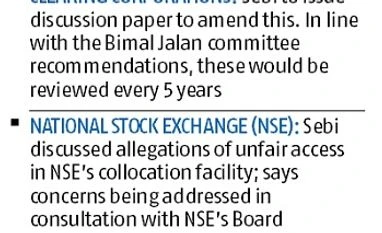
The market regulator said it would float a discussion paper. The proposal is in line with recommendations of a committee headed by Bimal Jalan, former Reserve Bank of India governor.
Sources said the new regulations might allow stock exchanges and clearing corporations to align salaries of their directors with the Companies Act. At present, directors of stock exchanges are paid only sitting fees.
The customary post-Budget board meeting was attended by Finance Minister Arun Jaitley and newly appointed Sebi Chairman Ajay Tyagi. This was outgoing chairman U K Sinha’s last board meeting.
Sebi also discussed allegations of unfair access at the National Stock Exchange’s (NSE’s) co-location facility and reviewed the participatory note (p-note) framework.
On the issue of unfair access at the NSE, Sebi said its technical advisory committee and the exchange’s board were addressing concerns related to systems and processes. “The board took note of steps taken by Sebi to strengthen data dissemination, monitor service quality of data feeds, manage system load, and direct connectivity between co-location facilities of exchanges,” Sebi said in a release.
The NSE faces allegations of allowing unfair access to trade data to some brokers at a co-location facility, which came to light in 2012 after a whistleblower wrote to Sebi.
The regulator hinted that the unfair access issue would not delay the NSE’s initial public offering. The exchange has filed an offer document with Sebi for a Rs 10,000-crore IPO.
On p-notes, Sebi said, “Consistent tightening of norms has not only increased compliance but also improved transparency.” It added the simultaneous liberalisation of the registration process for overseas investors had made participatory notes less attractive.
Sebi pointed out the notional value of p-notes as a percentage of overall foreign portfolio investor assets had declined from 55.7 per cent in June 2007 to 6.7 per cent in December 2016. A special investigation team on black money had argued p-notes were being used by Indian companies to bring back unaccounted money.
The Sebi board also discussed the action taken against brokers in the Rs 5,600-crore National Spot Exchange scam. Sebi has sent notices to five brokers for alleged violation of securities norms, which include false assurances to investors, wrong and misleading statements, arbitrage products sold with assured returns, misselling in terms of risk suitability for clients, and client-code modification.

 "Sebi plans to overhaul stock exchange norms")












 Connect with us on WhatsApp