Markets regulator Securities and Exchange Board of India (Sebi) has said a mutual fund house can have only one scheme per category. The move will impact a number of fund houses, particularly the larger ones that operate as many as a dozen schemes in some categories. Anthony Serhan, managing director, research strategy, Asia-Pacific at Morningstar, says the new rule is harsh. In an interview to Samie Modak, Australia-based Serhan, an expert on investment themes and trends, says India’s mutual fund industry has a lot of potential to grow. Edited excerpts:
Indian equity mutual funds are getting over $3 billion every month. Do you think that’s sustainable?
The record inflows into equity mutual funds (MFs) that are coming in are on an incredibly small base. I still think there is much more potential to grow. This is a secular change of moving away from gold and property and into financial assets. That’s just part of any developing economy. As the rates of urbanisation and modernisation increase, you will see more money going into financial assets. Most Indian investors have not been anywhere near the equities market before. The first thing you have to do is get them to recognise equities as an investment. You can grow the number of people by educating them about returns, about downturns and upturns. In Australia, the adult participation rate in equities is about 40 per cent; for India, it is not even 10 per cent. In the next five years, the inflow will be multiple times more.
The industry is going to keep growing. If you look at the size of the Indian market compared to other markets, it still doesn’t have the same economies of scale. Partly this is because of the absolute size. Distribution-wise, the geographic spread of India is very wide.
Sebi says the cost of investing in MFs should come down further. What are your views?
There is room for costs to come down. If you look at the US and other places, they charge just a few per cent of assets. The MF industry will have to share the additional revenues with investors to increase volumes. Importantly, this is not necessarily a case of sacrificing margin. If the volumes keep expanding, you can decrease your price. Also, as the market develops, there will be other ways of accessing financial markets. The exchange-traded fund (ETF) market in India will grow.
Why have ETFs not done well in India?
The distributors out there are paid to distribute MFs, and not to distribute ETFs. The ETFs will grow when you will have more of a self-directed market. Or, it will grow as the number of advisors increase. The industry today is largely a sales-led industry.
Sebi’s latest diktat says one fund house can launch only one scheme per category. How will this play out?
The one-scheme-per-category rule is a bit tough. Should you have 12? No. Should you have one? No. The answer is somewhere in between. Some of fund houses within large-caps may want to have different strategies, such as growth-oriented or value-oriented or concentrated. Therefore, three or four schemes per category are required to provide that kind of flexibility. I think one is harsh as there are different ways of managing money. From Sebi’s point of view, they want to avoid a situation where fund houses launch a new fund every six months.
What is your view on the proposal to segregate sales and advice?
It is very hard to be black and white about this. I think the best model is to have proper disclosures on conflict of interest. If you are going to push products of just one fund house, you have to say that upfront. Also, when you pay an independent advisor, you know how much you are paying him, but when you go through the distributor, the client should know how much the fund company is paying him. That needs to be disclosed properly. This is the difference between the MF industry and the consumer goods industry. You can’t just go about launching new products. Financial services is a trust product; there is a higher standard attached to it. That higher standard means that it is less about marketing and sales and more about taking care of your clients. If everyone does it well, the industry will grow.

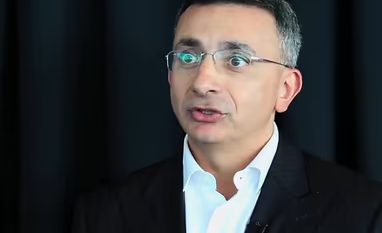 "Sebi's one-scheme-per-category rule is harsh: Morningstar's Anthony Serhan")












 Connect with us on WhatsApp