A sharp decline in export to China and slowing purchases from local fabric makers might prompt cotton yarn manufacturers to slowdown investment in new capacity addition in the next five years.
A study by rating agency Care Ratings forecasts 3 million tonnes of new spindle capacity would be added between FY16 and FY21. But between FY12 and FY16, the sector added 7.3 million tonnes of manufacturing capacity. By the end of FY16, the manufacturing capacity in the country was 50 million spindles.
The rapid growth, however, led to overcapacity, with fresh investment drying up. “Capacity addition will slow down as the cotton yarn industry will be adding only about 3 million new spindles between FY16 and FY21 because of overcapacity, subdued demand and lower benefits from the central government after changes to the Technology Upgradation Fund Scheme (TUFS),” said Darshini Kansara, research analyst, Care Ratings.
Demonetisation-induced cash crunch has forced the closure of smaller spinning mills; slow purchase from China has also forced manufacturers to lower operating capacity.
Since 2014, Chinese policy of using its internal resources rather than imports, cotton yarn off-take from the northern neighbour has declined consistently.
“The Indian cotton yarn market is experiencing overcapacity. Some large manufacturers had initiated their expansion plans but have put them on now,” said Rachin Lamba, head, exports, Winsome Yarns.
After declining by 10 per cent in FY12, cotton yarn production increased more than 14 per cent year-on-year to 3,583 million kg in 2012-13. In 2013-14, production increased by about 10 per cent to 3,928 million kg. High cotton prices and easy availability of manmade fibres at competitive rates led to the slower growth of production of cotton yarn. Production grew by marginal 3-3.5 per cent in FY15 and FY16. According to the Office of Textile Commissioner, cotton yarn production was 4,138 million kg in 2015-16.
By contrast, cotton yarn production is estimated to fall by about 5-7 per cent to 3,936 million kg in FY17 on the back of sluggish derived (domestic yarn demand) demand with substitution taking place from manmade fibre as well as distressed direct yarn exports due to lower demand from China. Yarn demand in other export markets including Vietnam, Bangladesh and Pakistan is likely to remain healthy.
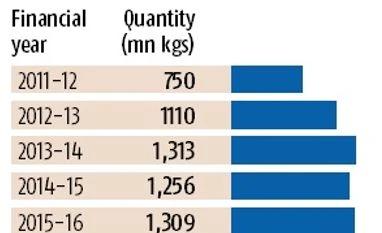
While cotton yarn exports to China are estimated to remain sluggish, the surge in shipment to other destinations may, by and large, compensate for it. Data compiled by the International Cotton Advisory Council (ICAC) estimates India’s cotton yarn exports at 1,250 million kg for FY17 as against 1,309 million kg in FY16.

 "Slow exports to China, sales hit yarn makers' investments")











