The disappointment of the Street on Shree Cement’s March quarter performance is visible in its stock price, down 1.6 per cent after the results were announced on Monday.
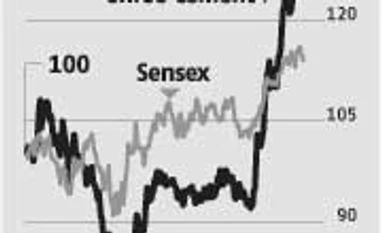
The expectation had been for better operational performance, some even hoping it to beat the market estimates. On the back of these hopes, as well as expectations of an economic revival, the stock had run up 35 per cent in two months.
Though cement realisation got a boost in the quarter, lower realisations in the power segment and increasing costs dented the performance. Ebitda (earnings before interest, taxes, depreciation and amortisation), at Rs 426 crore in the quarter, was lower than Bloomberg’s estimate of Rs 445 crore. And, analysts believe the near-term outlook is also not exciting.
Of the 23 analysts polled by Bloomberg after the results, 11 have a ‘Buy’ rating and 12 a ‘Hold’ or ‘Sell’ (six of each) on the stock. Their consensus one-year target price of Rs 5,876 indicates a limited upside from the current Rs 5,707.
Cement’s better Average cement prices in north and central India are estimated to have increased by about Rs 25 a 50-kg bag over those in the December 2013 quarter, as supplies got constrained due to a shutdown of the Binani plant and a temporary closure of Ambuja Cement’s Himachal plant. This benefited regional entities such as Shree. Though prices in other regions did not recover much and those in the south saw declining trends, limiting the gains for all-India players, Shree Cement’s exposure to north and central India accrued large benefits.
The company was able to dispatch 3.84 million tonnes, much more than the 3.44 mt in the December quarter and 3.26 mt a year before. Revenue from the cement business at Rs 1,487 crore was up 26 per cent sequentially and 28.8 per cent over a year. However, a rise in transport costs took the sheen away from higher realisations. Freight and forwarding expenses at Rs 343 crore were up 43 per cent year-on-year and 22 per cent sequentially, leading to the segment’s earnings before interest and tax falling 3.4 per cent year-on-year.
Cement accounted for 80 per cent and 78 per cent of revenues and profits, respectively, in the March quarter.
Power dims The power business contributed about a fifth of revenues and profits. It saw volumes decline 26 per cent over a year to 536 million units, due to sluggish demand for merchant power. Profitability from the segment was further impacted as per-unit realisation was Rs 3.20 compared to Rs 4 in the March 2013 quarter and Rs 3.40 in the December 2013 quarter. Per-unit Ebitda at 24p was much lower than the 91p in the year-ago period and 57p in the previous quarter.
Net down As a result of the weaker profitability in cement and power, Shree’s Ebitda at Rs 426 crore could grow only 5.1 per cent over a year, despite sales growing 16.2 per cent to Rs 1,660 crore. Margins, at 25.7 per cent, were much lower than the 28.4 per cent a year before. During the quarter, the company had extraordinary expenses of Rs 74 crore — however, offset by a tax credit for the prior period of Rs 68 crore. Adjusted for these, net profit fell 17 per cent year-on-year to Rs 228 crore.
Outlook While cement price rises from February bode well for realisations, the risk of these coming under pressure remain, with Binani’s plant coming back on track. Further, while cement demand from the infrastructure sector should get a boost after the elections, by the time the new government is formed, the seasonally soft period affected by the monsoon will have started.
Thus, any major revival in cement demand is likely to be only after the monsoon. Also, after the elections, oil companies are likely to resume their calibrated increase in diesel prices, which might keep freight costs elevated for cement companies. Power demand and realisations, too, are likely to remain subdued in the near term, feel analysts. It is, therefore, not surprising that analysts such as V Srinivasan at Angel Broking maintain a ‘Neutral’ rating on the stock after the results. Sanjeev Singh at Centrum Broking, though, has revised his target price upwards, looking at the better realisations — yet, this is much below the current price.
A few like Ravi Sodah of Elara Capital believe the company deserves premium valuations due to its efficient cement operations, healthy balance sheet and favourable regional mix. Thus, Sodah reiterates an ‘Accumulate’ rating, with a target price of Rs 6,050 (upside of six per cent).

 "Some cracks in Shree Cement's outlook")


 Connect with us on WhatsApp