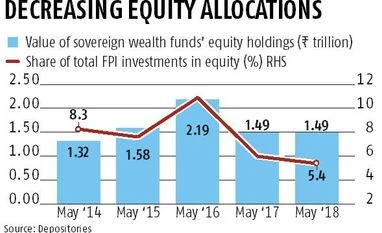
Sovereign wealth funds’ stock market bets were worth Rs 1.5 trillion, according to latest depository data as of May 2018. This is lower than the previous year, and reflects half-a-trillion drop from two years ago.
Meanwhile, overall foreign portfolio investments rose by over Rs 7.4 trillion from May 2016. Sovereign wealth funds’ share of foreign investments has dropped to 5.4 per cent in May 2018 from 10.9 per cent share in May 2016.
A sovereign wealth fund is owned by the government. It accumulates and invests money in various asset classes to meet the country’s future needs, such as retirement benefits for an aging population. They have emerged as a significant source of equity capital across the world, and are one of the top five categories of foreign investors in Indian equities. These investments are seen to be more stable than other sources of capital due to their long-term investment outlook.
West Asian sovereign wealth funds have already been withdrawing capital following the volatility in crude oil prices over recent years, according to a domestic brokerage executive who handled institutional broking. Domestic institutions have helped absorb the selling.
Mutual funds saw net inflows of Rs 82.4 billion in June 2018, according to data from the Association of Mutual Funds in India, including inflows into arbitrage funds and tax-saving equity schemes. This is higher than the average foreign portfolio outflows of Rs 10.7 billion a month in the first six months of 2018.
The effect on Indian equities in light of outflows should be limited so long as selling was in line with this recent trend, said UR Bhat, managing director, Dalton Capital Advisors (India). But there is a risk that sovereign wealth funds will see more selling. Reuters cited asset manager Invesco’s annual survey of sovereign investors and managers of central bank reserves, noting that over a third of sovereign investors were looking to reduce asset allocations to equity. High equity valuations and fears of a trade war are the reasons cited for reasons to cut equity holding.
Indian markets are trading above historical valuations, said Tirthankar Patnaik, chief strategist and head of research, India, Mizuho Bank. Emerging markets begin to look risky during a trade war scenario. Rising interest rates mean debt begins to look more attractive than equity.
“For a sovereign wealth fund, equities in general were expensive,” he added.
Some improvement in earnings is expected for India. A June 2018 Motilal Oswal Securities India Strategy report noted that markets would see better earnings, but markets would remain under pressure. “We expect FY19 to herald the earnings recovery for India, although the market will remain distracted by global and local macro events such as the ongoing global trade war, US Fed rate increase cycle, potential moderation in domestic equity flows and political developments,” according to the report.
One subscription. Two world-class reads.
Already subscribed? Log in
Subscribe to read the full story →
Smart Quarterly
₹900
3 Months
₹300/Month
Smart Essential
₹2,700
1 Year
₹225/Month
Super Saver
₹3,900
2 Years
₹162/Month
Renews automatically, cancel anytime
Here’s what’s included in our digital subscription plans
Exclusive premium stories online
Over 30 premium stories daily, handpicked by our editors


Complimentary Access to The New York Times
News, Games, Cooking, Audio, Wirecutter & The Athletic
Business Standard Epaper
Digital replica of our daily newspaper — with options to read, save, and share


Curated Newsletters
Insights on markets, finance, politics, tech, and more delivered to your inbox
Market Analysis & Investment Insights
In-depth market analysis & insights with access to The Smart Investor


Archives
Repository of articles and publications dating back to 1997
Ad-free Reading
Uninterrupted reading experience with no advertisements


Seamless Access Across All Devices
Access Business Standard across devices — mobile, tablet, or PC, via web or app
)