Uncertainty ahead, but don't panic
Even if the Delhi election results spook markets, use dips to buy ahead of Budget day
Ashley Coutinho Timing the market and devising an exit or entry strategy around an event like an election or a monetary policy can be tricky. Markets might move either ways and more often than not, you might not be able to make the right call.
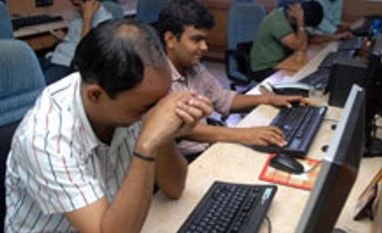
Two major events are likely to dictate the course of the market this month: the results of the Delhi assembly elections and the Union Budget. The first event has already taken its toll — in the last two sessions, the benchmark BSE Sensex has shed more than 600 points, on expectations of a win by Aam Aadmi Party.
If indeed the party emerges as victor on Tuesday, as predicted by the exit polls, there are predictions that more correction might be in the offing. So, what should be your investment strategy? Unfortunately, there are no hard rules.
“We are telling investors not to panic and stay invested,” said Rikesh Parikh, vice president – institution corporate broking, Motilal Oswal Financial Services. According to him, the impact of the Bharatiya Janata Party’s defeat will mostly be psychological and there is little to suggest the government's functioning will suffer. “If at all, it will serve as a wake-up call for the ruling party,” said Parikh.
Any downside from current levels might be limited, as the Nifty is likely to find support at 8,450 levels, its 50-day moving average. Any significant correction, though, should be used as a buying opportunity, said experts. Focus on quality stocks that have corrected substantially in the past 10-15 days. “Stay away from stocks that do not give valuation comfort. Avoid mid-cap and small-cap stocks as these have run up substantially,” said
G Chokkalingam, founder, Equinomics Research & Advisory. Added Parikh: “The current earnings season has been disappointing. So, stick to companies that have reported a good set of numbers. Remember, the market is near oversold territory, so a bounce-back can be expected.”
“Think of buying or selling only if the market reacts beyond 2-2.5 per cent. Buy stocks you are comfortable with. Don’t buy for one or two days but least for at 10-12 days because the Budget is round the corner and even the monthly expiry is near,” said Arun Kejriwal, founder, Kejriwal Research & Investment Services.
According to Chokkalingam, the market’s current trajectory might reverse post-Budget, especially if the government announces bold reform measures. For instance, the it might announce it is going ahead with restructuring of loss-making PSUs or lay down a roadmap for reviving the investment cycle. “These steps will be viewed as positive by the market,” he said.
Some experts feel that with the Budget a few weeks away, it would be a bad idea for investors to get in and out of stocks now as they might get the timing wrong. “If there is no immediate need to book profits and nothing much has changed fundamentally with the stocks you own, then stay put,” said Amar Pandit, a certified financial planner.

 "Uncertainty ahead, but don't panic")


 Connect with us on WhatsApp