Unlock BFSI 2.0: There's no irrational exuberance in market, say MF experts

Fund managers and chief executives of mutual funds (MFs) were speaking during the fourth part of a series of webinars being organised by Business Standard under 'Unlock BFSI 2.0'

Unlock BFSI 2.0
Nilesh Shah, managing director of Kotak AMC and chairman of the Association of Mutual Funds in India, re-iterated that MF investors needed to keep faith and be patient with their investments despite market volatility
Jash Kriplani Mumbai
4 min read Last Updated : Aug 21 2020 | 11:49 PM IST
The benchmark indices have jumped about 50 per cent from their coronavirus lows on March 23, leading to fears that they may have entered the bubble zone. However, India’s top money managers are largely of the view that the markets may not have run ahead of their fundamentals. They say the impact of Covid-19 is transitory in nature and the equity market is factoring in a potential recovery, which is likely to play out over the next one to two years.

Fund managers and chief executives of mutual funds (MFs) were speaking during the fourth part of a series of webinars being organised by Business Standard under ‘Unlock BFSI 2.0’.

“We need to appreciate that interest rates have fallen. Low interest rates increase the fair value of equity. Yes, the economy will de-grow. But the value of one-year loss of profit to the discounted cash flows of a business will be just 5 per cent,” said Prashant Jain, chief investment officer at HDFC Asset Management Company (AMC). “So, let us assume a business makes no profit in the current year. Its impact on the intrinsic value of a company is minimal,” Jain added. He pointed out that the markets were forward-looking, and they were possibly looking at the next year and the year after that.

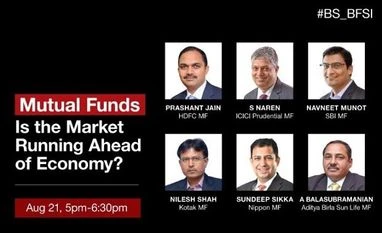
A Balasubramanian, managing director and chief executive officer of Aditya Birla Sun Life MF, emphasised the aggressive stimulus measures taken globally as well as domestically to tackle the Covid-19 crisis.

“This is the first time that policymakers have reacted so quickly.  In 2008, it took policymakers more than a year to react. The speed at which they have reacted this time is unprecedented,” he said. “In India, the government has announced Rs 20-trillion support. This is not a small amount." He didn’t rule out the markets surpassing their previous all-time highs before the end of the financial year.

Navneet Munot, chief investment officer at SBI MF, highlighted the fundamental difference between the markets and the economy. ”The markets are supposed to be forward-looking. There is little correlation between GDP growth and the markets. GDP is a lag indicator,” he said.

Munot said equities, bonds, and gold prices were all moving up together because of excess liquidity in the system. He said the economy could see a K-shaped recovery where “parts of the it will do well and parts will have to face challenges”.

On large outflows from equity MFs, Sundeep Sikka, CEO of Nippon India MF, said one needed to look at the type of investors who were redeeming. “A source of comfort is that investors with Rs 10,000-15,000 ticket-size are sticking with their investments and are holding on. It is high net-worth investors, who tend to time the markets and take advantage of short market movements, who are redeeming their investments,” he said.

S Naren, chief investment officer at ICICI AMC, said the sharp jump in the markets had lured investors into direct investing. “Investors are seeing that one-year fixed income returns can be made through the equity market in a week. They are getting more enthused,” he said. “There is lack of understanding of the risks. Only when there is a shock, people will understand the risks,” Naren said, advising investors to enter the markets in a sensible way.

Nilesh Shah, managing director of Kotak AMC and chairman of the Association of Mutual Funds in India, re-iterated that MF investors needed to keep faith and be patient with their investments despite market volatility. “This is the point of time when one needs to keep faith in systematic investment plans. If you don’t need money for emergency needs, stopping SIPs at this point of time will be a mistake because of low returns,” Shah said. He pointed out that if one continued SIPs in a bear market, it could give double-digit returns in a bull market.

On the recent episode of certain debt schemes being wound up, Shah assured investors that India’s MF regulations were among the most sophisticated and best in the world. “There will be recovery and money will be repaid to investors post-expenses,” he said.

One subscription. Two world-class reads.

Already subscribed? Log in

Subscribe to read the full story →
*Subscribe to Business Standard digital and get complimentary access to The New York Times

Smart Quarterly

₹900

3 Months

₹300/Month

SAVE 25%

Smart Essential

₹2,700

1 Year

₹225/Month

SAVE 46%
*Complimentary New York Times access for the 2nd year will be given after 12 months

Super Saver

₹3,900

2 Years

₹162/Month

Subscribe

Renews automatically, cancel anytime

Here’s what’s included in our digital subscription plans

Exclusive premium stories online

  • Over 30 premium stories daily, handpicked by our editors

Complimentary Access to The New York Times

  • News, Games, Cooking, Audio, Wirecutter & The Athletic

Business Standard Epaper

  • Digital replica of our daily newspaper — with options to read, save, and share

Curated Newsletters

  • Insights on markets, finance, politics, tech, and more delivered to your inbox

Market Analysis & Investment Insights

  • In-depth market analysis & insights with access to The Smart Investor

Archives

  • Repository of articles and publications dating back to 1997

Ad-free Reading

  • Uninterrupted reading experience with no advertisements

Seamless Access Across All Devices

  • Access Business Standard across devices — mobile, tablet, or PC, via web or app

Topics :CoronavirusMutual FundsMutual Funds industrystock market

Next Story




