Vegetable prices rise 20-25% as temperatures soar
Vegetable prices tend to be on higher side during summers due to supply shortage
Sanjeeb Mukherjee New Delhi The heat wave across northern and western India is not only taking a heavy toll on health, but also pushing up vegetable prices, particularly the green leafy kind, across cities and towns.
While vegetable prices tend to be on the higher side during summers due to supply shortage, prices started rising earlier than normal as temperatures have been on the higher side since the first week of April.
India Meteorological Department has forecast that the current phase of intense heat would continue for a few more days over western Rajasthan, eastern Madhya Pradesh, Vidarbha region of Maharashtra, Odisha and Kerala.
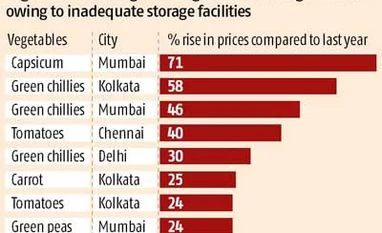
Vegetables tend to get damaged faster during summers owing to inadequate storage facilities.
Data sourced from the consumer affairs department and agmarket.nic.in showed capsicum, green pea, tomato and pointed gourd are 20-50 per cent costlier compared to last year in many cities.
In Kolkata, one kg of tomato had become costlier by Rs 14 in the past month, while in Chennai, it has become dearer by Rs 21 in the same period.
While the prices of potato and onion, two widely-consumed vegetables , have remained largely stable during the same period, that of other commodities remain a concern.
Agmarket data showed capsicum 70 per cent costlier in Mumbai during the week ended May 1 compared to the same period last year. Bottle gourd and cabbage prices have been on the higher side in the Azadpur wholesale market of Delhi and in the wholesale market of Mumbai during the week ended May 1 compared to the year-ago period.
Carrot prices in the wholesale markets of Delhi were 16 per cent dearer; in Kolkata, these were 24 per cent costlier.
Green chilli, another vegetable which gets damaged quickly during summer, was 30-60 per cent costlier in the main wholesale markets of Delhi, Kolkata and Mumbai during the April 25 to May 1 week compared to the same period last year. “There must have been some escalation in the prices of vegetables and fruits in the past few days, which is expected,” said a trader.
Earlier, the Reserve Bank of India (RBI) had cut its policy rate by 0.25 percentage points as inflation in April was down. It had said retail inflation dropped sharply in February after rising for six consecutive months owing to a larger than anticipated decline in vegetable prices.
The inflation dipped to a four-month low of 5.18 per cent in February from 5.69 per cent in January. If vegetable prices showed a rising tendency of acceleration going forward, it might not allow RBI to be accommodative as food inflation creeps into general inflation.

 "Vegetable prices rise 20-25% as temperatures soar")


 Connect with us on WhatsApp