Associate Sponsors

Co-sponsor

Volatility stares at bonds and rupee

Till date, foreign portfolio investors have pulled out Rs 44,568 crore from Indian debt
bonds
bonds
Anup Roy Mumbai
Last Updated : Jan 02 2017 | 12:01 AM IST
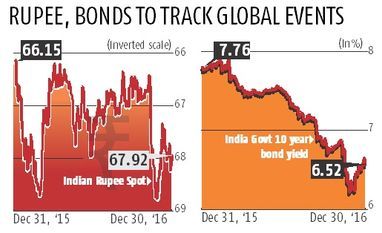
Movements in bond and currency markets in 2017 will be dictated by the global trends, say experts. Global bond yields and crude oil prices will directly impact local bonds, whereas the rupee would take cues from the stock market and the dollar.

If crude oil prices continue to firm up and global bond yields inch up, the scope for rate cuts by the Reserve Bank of India (RBI) will be limited. This should work against domestic bond yields. Bond prices and yields are inversely correlated. So, when bond yields rise, bond prices fall and vice versa. 

However, the huge liquidity accretion in domestic banks due to the note ban exercise is unlikely go away entirely and banks would be more or less flush with funds, at least till the end of FY17. This should support bond yields, says Saumyajit Niyogi, associate director, India Ratings and Research. Adding that global monetary policies hold the key much of the financial assets flow in 2017.

Bond yields closed at 6.52 per cent on Friday, sharply up from 6.20 per cent just before the monetary policy review on December 7, chose to hold rates steady. 

RBI might still cut rates by 25 basis points, possibly in the February policy review. But even that would be difficult, as foreign investors have been big sellers in the debt market. Till date, foreign portfolio investors have pulled out Rs 44,568 crore from Indian debt.

“Overall, 2017 is likely to be busy for traders and investors. Global liquidity would continue to chase yields. As of now, it is a bipolar world, with US looking to hike rates and rest of the major central banks looking to keep their policies accommodative,” said Abhishek Goenka, managing director of IFA Global, a currency consultant. 

In 2017, US yields could harden, giving more legs to the rally in dollar against all currencies. IFA Global estimates the US 10-year bond yield to move towards 3.4 per cent from around 2.44 per cent now and the dollar index touching 110, from 102 now by the end of calendar year. 

Still, the rupee could be one of the better performing currencies in emerging markets even as US rate hikes could be steeper than anticipated. 

In this context, currency dealers say the rupee testing 71 a dollar won’t be surprising.

For both currency and bond markets, Donald Trump’s policy decisions and Indian Budget math would be critical. Economists expect the government to maintain the fiscal deficit at 3.5 per cent of gross domestic product on increased tax revenues generated through income declaration schemes and potential gains from a shift of unorganised trade to formal economy.


One subscription. Two world-class reads.

Already subscribed? Log in

Subscribe to read the full story →
*Subscribe to Business Standard digital and get complimentary access to The New York Times

Smart Quarterly

₹900

3 Months

₹300/Month

SAVE 25%

Smart Essential

₹2,700

1 Year

₹225/Month

SAVE 46%
*Complimentary New York Times access for the 2nd year will be given after 12 months

Super Saver

₹3,900

2 Years

₹162/Month

Subscribe

Renews automatically, cancel anytime

Here’s what’s included in our digital subscription plans

Exclusive premium stories online

  • Over 30 premium stories daily, handpicked by our editors

Complimentary Access to The New York Times

  • News, Games, Cooking, Audio, Wirecutter & The Athletic

Business Standard Epaper

  • Digital replica of our daily newspaper — with options to read, save, and share

Curated Newsletters

  • Insights on markets, finance, politics, tech, and more delivered to your inbox

Market Analysis & Investment Insights

  • In-depth market analysis & insights with access to The Smart Investor

Archives

  • Repository of articles and publications dating back to 1997

Ad-free Reading

  • Uninterrupted reading experience with no advertisements

Seamless Access Across All Devices

  • Access Business Standard across devices — mobile, tablet, or PC, via web or app

Next Story



