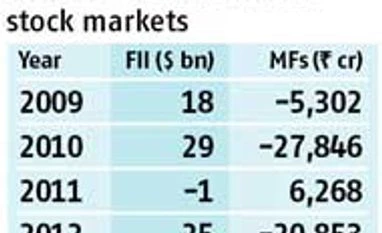
So far this year, investment by foreign institutional investors (FIIs), a key driver for the stock market rally, has crossed $14 billion, one of the highest among major emerging markets (EMs). The benchmark indices have rallied nearly 30 per cent in 2014.
Experts say foreign investor flows will have to remain strong for the market rally to sustain. Investors from abroad will have to put another $5 bn to surpass their last year’s tally of $19 bn.
“Currently, the Fed states that it anticipates a ‘considerable time’ between the ending of QE and the first rate hike, with this taken to mean six months or more,” he states.
FIIs had pumped in about $12 billion till August last calendar year. The pace of FII buying had picked up after August, when the Sensex was around 18,000. Since then, the market has rallied about 50 per cent and the Sensex trades above 27,000.
FII flows into the Indian market this year, like the previous year, have been more than most EM peers, such as South Korea, Taiwan or Indonesia. This could continue in case there is a rollback in US monetary policy, believe analysts.
“As we move towards expectations of a faster than anticipated normalisation of US monetary policy, we will see an increasing degree of investor discrimination within EMs. A sharp improvement in India’s external vulnerability indicators, a highly credible Reserve Bank of India, a government focused on economic growth and, importantly, an environment of softer global commodity prices should help India differentiate itself from many of its EM peers,” states Abhay Laijawala, managing director and head of research, Deutsche Equities India.
Even if the flows from the US market get slower, market players are betting investments will come from other regions such as Europe and Japan, where monetary policy continues to remain loose. “Investors from Europe, Japan and now China have expressed interest in investing in India. So, a large amount of money will come into the Indian markets,” said Deven Choksey, managing director, Choksey Securities.
Also, experts believe domestic institutions, such as mutual funds (MFs) and insurers, will provide support to the market if there is a slowing in foreign flows.
MFs, flush with investor flows, have pumped Rs 15,000 crore into the Indian market since the new government came to power in May. This is in contrast to last year, when MFs had sold shares worth Rs 20,000 crore; they have been net investors so far in 2014, to the tune of Rs 4,500 crore.
You’ve reached your limit of {{free_limit}} free articles this month.
Subscribe now for unlimited access.
Already subscribed? Log in
Subscribe to read the full story →
Smart Quarterly
₹900
3 Months
₹300/Month
Smart Essential
₹2,700
1 Year
₹225/Month
Super Saver
₹3,900
2 Years
₹162/Month
Renews automatically, cancel anytime
Here’s what’s included in our digital subscription plans
Exclusive premium stories online
Over 30 premium stories daily, handpicked by our editors


Complimentary Access to The New York Times
News, Games, Cooking, Audio, Wirecutter & The Athletic
Business Standard Epaper
Digital replica of our daily newspaper — with options to read, save, and share


Curated Newsletters
Insights on markets, finance, politics, tech, and more delivered to your inbox
Market Analysis & Investment Insights
In-depth market analysis & insights with access to The Smart Investor


Archives
Repository of articles and publications dating back to 1997
Ad-free Reading
Uninterrupted reading experience with no advertisements


Seamless Access Across All Devices
Access Business Standard across devices — mobile, tablet, or PC, via web or app
)