It was an unusual setting for an annual general meeting. None of the trappings of an AGM of a large listed company-banquet halls and elaborate arrangements for food and drinks- was there. Instead, about 30 shareholders had gathered in a small conference room on the 16th floor of the Birla Building, once the headquarters for many of the group firms, this month for the 68th AGM of Pilani Investment and Industries. The resolutions were passed and the meeting, which was closed to the media, was wrapped up in half an hour.
It was the first time the shareholders were meeting after the stock was listed on the National Stock Exchange, or NSE, earlier this month under the Securities and Exchange Board of India's plan for companies listed on defunct regional stock exchanges.
Pilani was listed on the Delhi and Madhya Pradesh stock exchanges before the two bourses were derecognised by SEBI in 2014. It used to be traded on the Bombay Stock Exchange and NSE under the "permitted to trade" category that allows certain securities listed on regional stock exchanges to trade on national exchanges. After the derecognition of the regional stock exchanges, however, the shares were also suspended from trading on BSE and NSE.
"The listing was a long standing request from minority shareholders," a Birla family source explains. "It will provide an exit route for minority shareholders," says Firoze Tandon, who owns 10 shares in Pilani Investment.
The shareholders, however, want to stay invested and for good reason. They expect Pilani to mirror the growth of its invested companies.
"Pilani is a key holding company for Birlas. It has significant stake in Century Textiles and Kesoram Industries. Both are in the news. The shares might appreciate going forward," Tandon explains.
In October, Basant Kumar Birla-controlled Century Textiles and Industries appointed Kumar Mangalam Birla (his grandson) as its vice-chairman in what is being read as a clear indication that he would lead the company in the future. Kesoram, also a B K Birla company, is in the process of raising funds and restructuring itself.
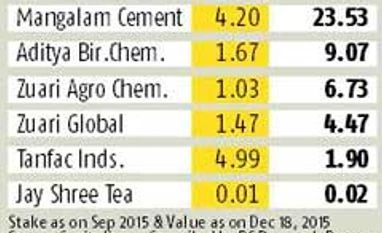
In addition, Pilani Investment has stake in 11 other listed companies. Among them are Aditya Birla Chemicals, Century Textiles, Grasim Industries, Hindalco Industries, Aditya Birla Nuvo, Jay Shree Tea, Kesoram Industries, Mangalam Cement, Tanfac Industries, Zuari Global and Zuari Agro Chemicals. Except for the two Zuari companies, the rest belong either to Basant Kumar Birla or Kumar Mangalam Birla. The combined value of Pilani's holding is estimated at around Rs 4,100 crore. That's what is keeping the interest of the shareholders alive, the minority and majority alike.
Within the company, however, the balance of power is skewed against retail investors who account for just nine per cent of the equity holding; fifty-seven per cent stake is with Basant Kumar Birla and Kumar Mangalam Birla, while the Harsh Lodha family has 25 per cent by virtue of the bequest by Priyamvada Birla, widow of Madhav Prasad Birla (Basant Kumar's cousin). Some shares are also understood to be with close associates of the Birla family.
Valuation problems The valuation of Pilani has always been difficult to ascertain. When the Birla group divided businesses in the 1980s, Pilani was not part of it. "Valuation was an issue, it was just left hanging in the air," Sudarshan Kumar Birla (Basant Kumar's nephew) says.
However, Pilani Investment gained prominence in the Birla group's scheme of things in 2004. Shortly after the death of Priyamvada Birla that year, a will bequeathing her estate believed to be worth around Rs 5,000 crore to well-known chartered accountant and auditor for many Birla companies, Rajendra Singh Lodha, surfaced. It had layered implications. Primary among which was, a rank outsider had got a large share of the wealth created by the family.
Different members of the Birla family waged legal battles to challenge the will made in 1999. The number of cases reached 110 at one point, while the main case, the probate of Priyamvada's alleged will of 1999, is still pending trial. The challenge from the Lodhas also meant Pilani Investment, and its holdings had to be fortified.
In 2005, Basant Kumar Birla reached a pact to acquire the stakes of Sudarshan Kumar Birla and his other nephew, Chandra Kant Birla. Sudarshan Birla had a little more than seven per cent while Chandra Kant had 20 per cent. The deal was consummated at a price of Rs 1,500 a share. Krishna Kumar Birla too transferred his shares to Basant Kumar Birla. It all added up to 57.57 per cent for Basant Kumar and his grandson.
"It was a gentleman's agreement," recalls Sudershan Kumar Birla. Sudarshan Kumar initially had 15-16 per cent that he sold over 20 years.
Members of the Birla family are optimistic that the listing on NSE could pave the way for the exit of the Lodhas. However, a deal is unlikely any time soon. Sources close to the Lodhas believe that a "fair valuation" and a negotiated deal, as among the family members a decade ago, could make them think of exiting the company.
The valuation is difficult to quantify. The stock price does not reflect the true value of Pilani, says a company insider. "The value of Century Textiles's real estate assets is not factored in the market capitalisation of the company," the source explains. Century has a land bank of 40 acres, most of which is in Mumbai's business district. With 57 per cent or more on their side, the Birlas are unlikely to be in a hurry to strike an expensive deal.

 "With NSE listing, Birlas fortify their hold on Pilani")


 Connect with us on WhatsApp