History is a battlefield — not only for those fighting in these battles, but also for those chronicling it, that is, the historians. A few years back, I reviewed a book, The Ivory Throne, about the House of Travancore in Kerala and its extraordinary regent Sethu Lakshmi Bayi. The tome ran well into 700 pages and it took me a while to read it, but the intricate narrative blew my mind. The author, Manu S Pillai, went on to win the Sahitya Akademi Yuva Puraskar the next year. He followed it up with Rebel Sultans, a history of the Deccan Sultanate. As if two thick books in three years were not enough, he has published a third one this year, The Courtesan, The Mahatma and the Italian Brahmin.
So when I meet him in Delhi, I am compelled to ask what many of his readers and admirers have been wondering: How does he write so many books so quickly? “The first book took me about six years to write,” he says, “So it was a long-drawn process. The second one took about two years — and it was published two years after the first one. This book, the third one, comprises essays I have written over the past three or three-and-a-half years for my weekly column (“Medium Rare” in The Mint).” He adds that he practically lives in the archives and libraries. “It is pretty much my 24x7 job now,” he says, “which also means I want to keep producing this work.”
We are at Perch, a chic café at Vasant Vihar, in south Delhi. Pillai suggests we order a Vietnamese-style pour-over coffee and a cheese platter. I ask for a meat platter as well.
Unfortunately, for my purposes, it was not the ideal location, what with the ambient music and the large turnout. The reason why it is so popular becomes obvious when our order is served.
“I have been out since morning recording another podcast,” Pillai says, “and will be going to Khan Market for a book signing after this.” Being a famous author is hard work, isn’t it?
I have read Pillai’s latest book cover to cover, and have deciphered its enigmatic title, but I also want to hear it from him. “The title represents some major interests I have in my research,” he says, before embarking on an explanation. The Courtesan refers to any one of the six courtesans in the book. “In 2019, why are we still thinking of history as if it’s only about kings and battles and empires,” he says. “Why is there no history through the eyes of women?” Courtesans are a wonderful way to look at history, since they were often highly educated, refined and great contributors to society. One of the courtesans in Pillai’s book is Begum Samru, who begins her career as a dancing girl in Delhi and goes on to become a military leader with her private army, often protecting the vulnerable late Mughal emperors.
“The Mahatma does not refer to Mahatma Gandhi, as some might think,” says Pillai. “It refers to Mahatma Phule, who — long before Gandhiji turned up at Buckingham Palace in a loincloth to scandalise everyone — arrived at a banquet for the grandson of Queen Victoria in Pune in a torn shawl to show the mirror to colonial rulers.” Pillai asserts that Phule has been garlanded and enshrined as a social reformer, but this sort of veneration sanitises his rather radical polemic. “He lived in Pune, which was a seat of Brahminical orthodoxy. Brahmins claimed that they were superior, being born from the head of the cosmic creator. Phule asked: ‘Does this mean the cosmic creator menstruates through his mouth?’.” Similar questions were asked by Kabir or Basava — both of whom feature among the dramatis personae in Pillai’s book. “Indian history is as much about asking questions as it is about sanctified thought,” he adds.
In the introduction to his book, Pillai writes: “We live in times when history is polarising. It has become to some an instrument of vengeance, of grievances, imagined or real. Others remind us to draw wisdom from the past, not fury and rage, seeing in its chronicles a mosaic of experience to nourish our minds and recall, without veneration, the confident glories of our ancestors.” I ask him where he sees himself in this rather conflicted landscape. “I am trying to regain that elusive thing called balance,” he replies, smiling. “History is neither on the extreme left, nor on the extreme right — it is somewhere in the middle. It is necessary to reclaim that middle ground, especially in our contemporary world where everything seems to be so black and white.” He asserts that the contemporary polarisation over historical narratives tells us more about our insecurities and anxieties than about history.
Perhaps, a consequence of this anxiety is a spurt in popular history writing in India — Pillai is arguably the biggest success story of this phenomenon. (His first two books were bestsellers, and this one is well on its way to becoming one.) At the same time, there seems to be a conflict of sorts between popular history and traditional or academic history. “Where do you see yourself in this?” I ask him. “I see myself as a bridge between the two,” he replies. “I bring academic rigour to my writing. The Ivory Throne had more than a hundred pages of critical material. All my work involves the archives. But I don’t write like an academic.” Pillai says many historians are doing great work, which often remains confined to academic circles. “It is essential to bring it to a wider audience,” he adds, “because everyday history is being mutilated for political purposes.”
For politicians, he says, context is a bad thing. “They need grand narratives, things in black and white — but there are no dichotomies in history,” Pillai says, providing examples from his book. For instance, Sir Arthur Cotton, a military engineer responsible to irrigating vast stretches of Andhra Pradesh, and where even today, there are more than 3,000 statues of the man in two districts. Or, the Maharaja of Jaipur who stood with the British during the First War of Independence in 1857 but went on to build hospitals and bridges and modernising his kingdom. “Is he good or is he bad? What do you focus on?” Pillai asks. “As I said, context is very important.”
He also narrates the story of Shahuji Bhonsle, the nephew of Maratha ruler Shivaji, who ruled Thanjavur from 1684 to 1712, and was also a poet and playwright of some talent. In his play, Sati Dana Suramu, he parodies social conventions with a Brahmin besotted with a “untouchable” woman. Overcome with desire, the Brahmin abandons all caste traditions. The woman tells him why they cannot sleep together: “We eat beef, we drink liquor.” The Brahmin replies: “We drink cow’s milk but you eat the whole cow. You must be more pure.” Pillai asks: “Can you imagine a contemporary playwright writing this?”

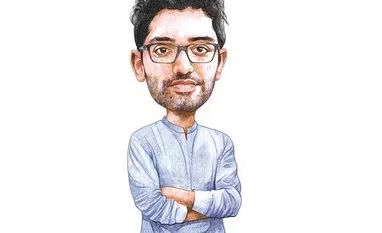 "Author Manu Pillai on finding balance in 'conflicted landscape of history'")












