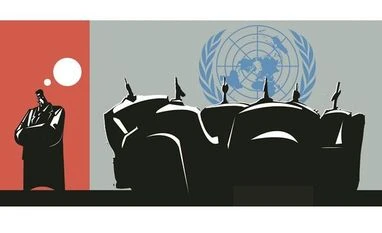
A permanent, veto-wielding seat on the United Nations Security Council (UNSC) is India’s right, according to India. The anger, irritation and frustration at not being accorded this entitlement show up on occasion as it did this week in New York. The Hindustan Times reported it on November 18 under the headline “Impaired organ: India slams UNSC on slow pace of reforms”. Apparently, we feel “deep frustration with the change process that has been on for many years without progress”.
The report also tells us why there has been no progress on reforming the Security Council. The fact is that we are not the only contenders for a position at the high table. There are others, and they also feel they are being denied.
The report said: “While there is a broad consensus for reforming the Security Council, some countries — loosely called the Coffee Club — have opposed it to block the claims of countries that they believe are their regional rivals. Pakistan is a member of this club. Other members are Argentina, which opposes Brazil’s claim; Italy and Spain, who oppose Germany; and Australia, which opposes Japan.”
China will also oppose Japan of course, as it does India. The reform cannot be done without total consensus, especially of our rivals. China has a veto on our entry and the idea that it will want us to share its power on the global stage formally is delusional. Holders of power do not want to dilute it unless compelled to. France is a second rate power today, as is the United Kingdom. Why on earth would they want to voluntarily let go of whatever they have remaining or in some way let other nations share it? Of course they will not.
What can India do? Not much, other than express frustration. And this is amplified by the fact that Pakistan constantly and publicly insists that India should be denied the place, as it again did this week. Our permanent representative to the UN said Pakistan was obsessed by India and its response was Pavlovian. Perhaps, the same can be said of India when it comes to Pakistan.
As someone who has seen this being replayed over the decades, it is hard not to find India’s behaviour comical. We demand to be given our due and be allowed to play with the big boys on the global stage but our focus is on Pakistan and “cross border terror” and little else. Our field of vision is narrow. Going through the annual appearances of India at the UN General Assembly, if we were to remove the carping about Pakistan from the speeches of the prime minister and foreign minister, little of substance would remain. It appears as if we cannot help but be Pavlovian. India cannot get even the SAARC to function regularly, but thinks we have something of value to offer the rest of the world.
The question to consider is why India wants a position on the Security Council. The Jana Sangh’s first manifestos said the party would seek a place on the Security Council but offered no path to getting there or explaining why it was important that the place be secured. It appears that we want the honour for two reasons, of which one is defensive.
After India rescinded from its promise to conduct a plebiscite in Kashmir (this was conditional on Pakistan military vacating western Kashmir, which it did not do) we tried for decades to ensure that the UN resolutions on a plebiscite in Kashmir died or became dormant. Many Indians might not know of the existence of the United Nations Military Observer Group, and its presence in India to oversee our dispute with Pakistan. In 2014, the Modi government ordered it to vacate its office on Purana Qila Road in Delhi, without knowing that this was not possible. The office still exists of course.
India has always felt international pressure over its actions in Kashmir and has sought to head it off through securing a veto. This is the primary reason, a defensive one, that we want the position. What can we do on the Security Council that we cannot potentially do today outside it?
Germany and Japan wield far more influence in the world than France, though neither has a place on the Security Council or even a proper army.
China’s rise in the world has not come because of its place on the P5. It has come because of its economic growth and its ability to project that power through trade and giant global infrastructure projects. Not so much its ability to wield a veto on Security Council affairs. India’s real problem is that it has a fifth of China’s economic power, not so much that it doesn’t get to sit at the high table. If we had China’s economic power, it would not matter as much that we were not on the Security Council.
Illustration: Ajay Mohanty
The other reason we want to be on the P5 is our entitlement based on the size of our population and the fantasy that we are a civilisational entity of higher quality than others. This is supposed to make the rest of the world go weak at the knee and hand us our rightful inheritance. The first is a non-starter because the United Nations is a gathering of nation-states not ranked by population. On the second, there is not much to say other than, even if it is in some small measure true, India’s behaviour over the last few years has done much to undo it in the minds of many. We don’t have to go there today.

 "Beyond a seat at the UN high table")












 Connect with us on WhatsApp