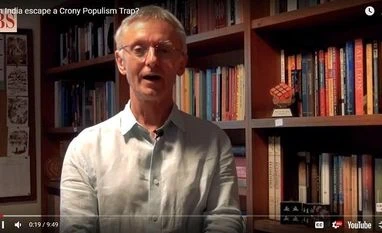
Can India transit from billionaire raj and escape a crony populist trap?

India's real risk is not that crony populism would fail, but that it would succeed, consolidating a path that is fundamentally a trap, both in terms of social inequalities and long-term growth

Can India escape a crony populism trap?
Michael Walton
Last Updated : Aug 27 2018 | 9:43 AM IST
A striking feature of the current global wave of populism is that populist leaders often maintain close links with their business supporters. Donald Trump mobilises his base, rails against “elites” and delivers regulatory favours and jobs to his business pals. Crony populism is a better name for this. This typifies Turkey under Recep Tayyip Erdogan and Hungary under Viktor Orban… and India under Narendra Modi. Is India becoming entrenched in a crony populist trap? Are there forces that will pull it out?

How to think about crony populism? Let’s start with populism. As economic historian Barry Eichengreen argues in his history of populism in the US and Europe, these movements have three core characteristics: Anti-elite, nativism, and economic nationalism (typically via protectionism). This generally comes with charismatic leaders boasting a direct link with “the people”, authoritarian preferences, and a cruel underbelly, targeted at “other” groups. 

But political leaders also need business support, for political finance and investment. Here the combination of economic nationalism and concentrated, personalised leadership provides fertile ground for links with cronies. Crony populism involves a blend of a classically tight link between the political leadership and core business supporters, plus a powerful narrative and action supporting the favoured core popular constituency, including demonising other elites and outsider groups. For charismatic political entrepreneurs with a common touch, this is a great strategy, whether it builds off economic insecurity and cultural anxiety amongst historically dominant social groups, as in the US and Europe, or the much-celebrated, rising aspirations of middle and lower groups experiencing new forms of insecurity and anxiety in developing countries. 


Take Trump and Modi. While their background and styles are very different, there are strikingly common patterns. Both have a brilliant capacity to sense and mobilise popular sentiment amongst their base. Trump channels the anxieties and concerns of the white working class; Modi of middle and poorer groups sick of daily corruption. Both skillfully use anti-elite narratives, whether against Wall Street for Trump, or India’s established elites, especially, of course, the Nehru-Gandhi clan. Both brilliantly manage narratives on populist policies that their bases support, even when these hurt them: Trump’s tariffs; Modi’s demonetisation. Both enjoy widespread support from the business sector. And both sustain support through explicit or implicit demonising of the “other”— Mexicans and African-American for Trump, and Muslims for Modi, in his de facto embrace of Hindutva ideology.

But for India, isn’t it true that Modi swept to power on an anti-corruption and pro-development discourse, exploiting the fertile ground of the scams and rampant cronyism of the second UPA period? And hasn’t high-level corruption declined? All observers agree that the pervasive transactional corruption of the late UPA period has been brought under control in the Centre. However, the new pattern appears to be of favoured gains for the truly influential, often in legal forms, even as fears of investigation have cast a chill over much regular investment activity. The real plutocrats have apparently done well. According to Forbes, India’s top 10 billionaires have enjoyed a rise in their net worth of some two thirds between 2014 and 2018. Mukesh Ambani has seen his net worth rise by over 115 per cent. Gautam Adani has enjoyed a rise of almost 250 per cent. This is rather more than the growth of incomes of most Indians (Figure 1).

If India is indeed consolidating a form of crony populism, what are the consequences? Hasn’t growth been pretty good? This is where the internal contradictions emerge. First, populist strategies have to promise short-term benefits, whether in free televisions, loan write-offs, or universal health.  These lead to fiscal pressures. Second, while the cronyist dimension can deliver for a while — in political finance and major investment deals — it is eventually inefficient, leading to major rent extraction and a return of the anti-plutocrat sentiment. Last but not least, exclusionary politics intensify polarisation.

Populism rarely gets aligned with the goal of efficient, inclusionary social and economic policies.

But can India transit from The Billionaire Raj (in the evocative name of James Crabtree’s book), as the US did a century ago? The populist response to the US gilded age was followed by the progressive movement, with an array of executive, legislative and judicial action to curb the power of the “robber barons” and introduce a range of protections for workers and citizens, consolidated (after a massive economic crisis) in the inclusionary new deal. But the US historical transition occurred in the context of an effective alignment between populist movements, a vigorous and independent press, civil society activism, an independent Supreme Court, and competitive major parties. In each of these areas India’s current direction of travel is in the opposite direction. The larger risk is of the intensification of an exclusionary Hindutva-based resolution with rising authoritarianism — more like the current Turkish and Hungarian route, and undoubtedly the one Trump would like to follow, if only he could. India’s real risk is not that crony populism would fail, but that it would succeed, consolidating a path that is fundamentally a trap, both in terms of social inequalities and long-term growth.
(This is part of a dialogue series of the Centre for Policy Research and Trivedi Centre for Political Data, Ashoka University )
The author teaches at the Harvard Kennedy School and is senior visiting fellow at the CPR


One subscription. Two world-class reads.

Already subscribed? Log in

Subscribe to read the full story →
*Subscribe to Business Standard digital and get complimentary access to The New York Times

Smart Quarterly

₹900

3 Months

₹300/Month

SAVE 25%

Smart Essential

₹2,700

1 Year

₹225/Month

SAVE 46%
*Complimentary New York Times access for the 2nd year will be given after 12 months

Super Saver

₹3,900

2 Years

₹162/Month

Subscribe

Renews automatically, cancel anytime

Here’s what’s included in our digital subscription plans

Exclusive premium stories online

  • Over 30 premium stories daily, handpicked by our editors

Complimentary Access to The New York Times

  • News, Games, Cooking, Audio, Wirecutter & The Athletic

Business Standard Epaper

  • Digital replica of our daily newspaper — with options to read, save, and share

Curated Newsletters

  • Insights on markets, finance, politics, tech, and more delivered to your inbox

Market Analysis & Investment Insights

  • In-depth market analysis & insights with access to The Smart Investor

Archives

  • Repository of articles and publications dating back to 1997

Ad-free Reading

  • Uninterrupted reading experience with no advertisements

Seamless Access Across All Devices

  • Access Business Standard across devices — mobile, tablet, or PC, via web or app

Next Story