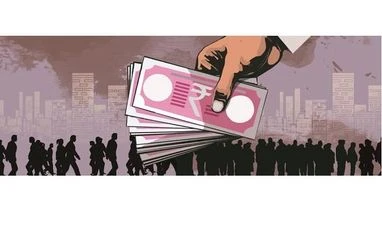
Universal basic income (UBI) is an elegant model for economists. It has now been attracting a lot of attention all over the world, including the rich countries. The scheme is that all people in the country will get some cash without any relation to the work. Abhijit Banerjee, the Nobel laureate, in his book Good Economics for Hard Times, has made an elaborate case for Universal basic income. He calls it ultra basic (UUBI) because "any universal income that governments of poor countries can afford will be ultra basic”. Hence UUBI (page295). He further adds: "Given all this, the best combination may be a UUBI everyone can access when they need it, and larger transfers targeted to the very poor and linked to preventive care and children's education." Professor Pranab Bardhan suggested in his articles in Business Standard (on June 9,10, and 11, 2020), a cash grant of Rs 20,000 to each family irrespective of rich or poor but has finally conceded that it need not be given as a practical measure to plutocrats. Raghuraman Rajan has talked only about the poor, "We have seen over time that giving money directly to the people is often a way of empowering them. They can use that money for the services they need." The Economic Survey of India proposed something like this in 2017. It estimated that an annual transfer of Rs 7,620 to 75 per cent of India’s population would push all but the absolute poorest above the 2011-12 poverty line. UBI is for mitigating insecurity and abject poverty and not inequality.
According to me, UBI for all or 75 per cent people is absurd. Even ICRIER working paper 393 (June 2020) wants a targeted approach, not universal. The cut-off point has to be such as to cover only the poor. For example, those who do not pay income tax, that is, less than Rs 5 lakh net income per year. So this will be a clear cut definition. The limit is negotiable.
In some countries/states UBI has been experimented but details are not either available or fully reliable. Reports show that Kenya, Alaska, and Iran have tried it. Canada has been mentioned on the Internet but my authentic enquiry shows that Canada does not have a UBI. Canada has targeted help to the needy. Old people, after age 65, get an income supplement, so do families with children, but these are clawed back from high-income people. There are provincial programmes to help the poor in various ways, mainly providing housing, food and cash.
One argument that is cited against UBI is that it may generate laziness. The experiment is Kenya, quoted by Abhijit Banerjee and Bardhan, shows that it does not. I agree with that.
Now we discuss how to find out the resources. On this issue, no detailed suggestion has been given by the three economists. Abhijit Banerjee has quoted the Economic Survey (p 295), which puts the cost of such a scheme at 4.9 per cent of India’s GDP. He has said India’s fertiliser, petroleum, and food subsidies cost 2.07 per cent of GDP in 2014-15. And the 10 largest central welfare schemes cost 1.38 per cent. Cutting these existing programmes entirely would pay for about two-thirds of the UBI.
Abolishing these welfare programmes and giving that money as direct cash transfer actually means redistributing the existing schemes differently. Moreover, the fertiliser and food subsidies would damage agriculture. In one line, he dismisses the issue without any proper discussion. Again, his suggestion goes directly against the suggestion of Bardhan, who wants the existing welfare schemes to continue. He wants some of the exemptions to SEZ (Special Economic Zone) be abolished. He has not discussed the impact in any detail. He wants wealth and inheritance tax to be imposed. Unless these suggestions are discussed threadbare with fiscal bureaucrats, like expenditure secretary and revenue secretary face to face, with the economists who have proposed such far-reaching changes, the consequences of such proposals will remain vague and apparently unworkable.
The conclusion is that the UBI proposal of giving Rs 20,000 to every family is a delusion. Giving to those up to a cut-off point is probably practicable. In principle, I support it. The scheme can begin with less amount.
The writer is a retired member of the Central Board of Excise & Customs
E-mail: smukher2000@yahoo.com

 "Financial viability of universal basic income")












 Connect with us on WhatsApp