A few weeks ago, there was a news item. A steam locomotive derailed at the Rewari Railway Heritage Museum, earlier known as Rewari Steam Locomotive Shed. This is the famous locomotive Akbar, aka WP 7161, built by Chittaranjan Locomotive Works (CLW) in 1965. For a very long time, especially in the 1960s and 1970s, before diesel and electric took over, WP (broad gauge, passenger) locomotives did the bulk of the work for the Indian Railways (IR). Initial WP locomotives were manufactured by Baldwin Locomotive Works (Philadelphia), later ones in Canada, Poland and Austria and still later ones in Chittaranjan. (All WP locomotives have a cone-shaped nose, often with a silver star.) When was India’s last steam locomotive manufactured? The answer depends on the gauge, so let’s stick to broad gauge (signified by W). The last such steam locomotive was built in 1970 and was understandably named Antim Sitara. For a long time, we were rather shoddy about preserving our railway heritage, including steam. But Antim Sitara has been preserved (it is not in working condition) in CLW. Antim Sitara was a goods locomotive, WG. Akbar must have been one of the last of the WP locomotives built. (The last one was built in 1967.) It had been consigned to oblivion in Siliguri, before it was brought to Rewari and resurrected. Having featured in several films, including Bollywood ones, it is reasonably famous.
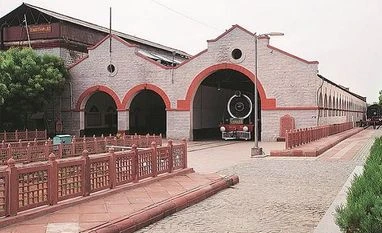
Chugging to an end: Built in 1893, Rewari Steam Locomotive Shed was turned into a museum in 2002 and given a new name, Rewari Railway Heritage Museum. Photo: Wikicommons
Sixteen steam locomotives are still in working condition and 11 of them are in Rewari. The oldest among working ones are the twins Express (in Perambur) and Fairy Queen (in Rewari), constructed in 1855. Earlier, the Fairy Queen used to chug along from Delhi to Alwar (the Steam Express) between October and March. The Steam Express then continued with Akbar doing the pulling. Some years ago, my wife and I travelled on that trip and it was quite an experience. Obviously, the market didn’t think that, or marketing didn’t work. The Delhi-Alwar-Delhi trip was commercially unviable and closed down. There is now a Steam Express from Delhi to Rewari. The Alwar Steam Express was over the weekend, the Rewari one is a day’s trip. You leave Delhi Cantonment in the morning and return in the evening. On the way to Rewari, it will be the Fairy Queen. On the return, it will be a more pedestrian diesel locomotive. Unlike the Alwar trip, there is no catering on this train. It leaves every second Saturday, with a possible fourth Saturday trip if at least 50 per cent of seats (out of 60) are booked. The two-way ticket costs a little less than ~6,500. But for half the cost, you can also buy one-way tickets. Recently, my wife and I travelled on this. There were a few people on the outward journey. On the return, it was close to empty. We were told the foreign tourist season will make a difference. But I suspect, despite attractions in Rewari, this will also prove to be commercially unviable and will close down.
In Rewari, Akbar has another steam locomotive (WP 7200) as a companion. This is older and was built in 1947 by Baldwin Locomotive Works. This had been consigned to oblivion in Howrah, though it has historical value. It was presented to IR on 15 August 1947, though it arrived on Indian shores in October 1947. Therefore, despite being initially dubbed Shahenshah, it eventually got the name Azad. Of the 11 steam locomotives in Rewari, seven are broad gauge and four metre gauge (all manufactured by TELCO in the 1950s and 1960s). Each metre gauge locomotive has a story to tell. However, most people are probably more fascinated by broad gauge ones, the likes of Fairy Queen, Akbar, Azad and Virat (AWE 22907). Virat was built in 1943 by Baldwin. There is a bit of history associated with Sher-E-Punjab (WL 15005), built by Vulcan Foundry in 1955. On 6 December 1995, this hauled the last time-tabled broad gauge steam passenger train, between Firozpur and Lohia Khas. But there is some more history associated with Sher-E-Punjab. Post-retirement, in 2007, it was hauling Palace on Wheels (without any passengers) and because of a boiler malfunction, the driver and an inspector died. The police seized the locomotive as “case property” and it required court intervention for it to be released in 2007.
Built in 1893, Rewari Steam Locomotive Shed is also old. It was a metre gauge shed, with a metre gauge line between Delhi and Rewari constructed in 1873. In those metre gauge days, Rewari was a major junction, with lines radiating towards Rajasthan, Gujarat and Punjab. Trains from Delhi towards any of these directions had to pass via Rewari. With gauge conversion, Rewari junction’s importance remains, but a metre gauge locomotive shed became irrelevant. After celebrating the centenary, the shed was closed down, as a steam locomotive shed. For a few years, it functioned as a metre gauge diesel locomotive maintenance shed. But not only was steam dead, metre gauge was also dying. In 2002, it was announced that Rewari Steam Locomotive Shed would become Rewari Railway Heritage Museum. To add to metre gauge, broad gauge lines had been laid in the shed. But where were the locomotives? (In fairness, Rewari possesses railway heritage beyond locomotives.) Especially after 2010, the ones I mentioned were gradually brought there and restored to working order. Unfortunately, other than locals and die-hard tourists, especially of the foreign variety, not too many people go there. The author is chairman, Economic Advisory Council to the Prime Minister. Views are personal

 "Rewari Museum needs some steam")












 Connect with us on WhatsApp