Last month, the Reserve Bank of India (RBI) released a set of financial conditions indices (FCIs) for different markets like stocks, currencies, bonds as well as an aggregate index for the financial markets as a whole. These are meant to give policymakers and market watchers a heads-up on whether things are likely to go smoothly or whether there's rough weather ahead. A more primitive version that's been around for a while is the monetary conditions index (MCI) that perhaps doesn't get the attention it deserves. It's perhaps time to bring the MCI centre stage.
The bottom line of the MCI (as well as its more sophisticated variant, the FCI) is that monetary policy is not just about interest rates. In obsessing over interest rates in our often copious discussions on monetary policy, we miss the other variables that monetary policy impacts and, through them, drives changes in the economy. A comprehensive gauge of these different "channels of transmission", as the jargon goes, instead of an exclusively interest rate-centric approach could potentially change the conversation on monetary policy
What are these channels? Econ 101 suggests that monetary policy affects the exchange rate and drives changes in stock and other asset prices creating a "wealth effect" for households, inducing them to spend more if their portfolios swell (whether a central bank should try and control asset price inflation has been the subject of many a heated exchange between economists.) Finally, the volume of credit available to firms and households affects spending and output and has to be bunged into the MCI.
Constructing this combined gauge is not a ground-breaking innovation. The central bank of Canada developed a monetary conditions index (MCI) in the early 1990s and actually used it as its operating target (the way the RBI targets consumer price inflation now). Many other central banks like the Bank of New Zealand either used it as a target for monetary policy or as a guide. The RBI estimated its own index in 2006* but did not put an updated version in the public domain.
The interesting thing about the MCI is that the very process of its estimation gives us interesting insights into the working of the economy. In choosing the weights for the different channels of transmission, it becomes critical to figure out their relative importance in influencing either aggregate output or inflation in the economy. Again, anyone who has sat through a first Econ 101 lecture will appreciate the fact that policies tend to work with leads and lags. The demand or output model underpinning the MCI gives a clear picture of how these work.
Without lapsing into excessive jargon, let us assure the ever-fretful econometricians that we are not guilty of any gross statistical impropriety. All variables except stock-market returns (we have our reasons for this) are expressed in real terms. We take the overnight Mibor (the Mumbai Inter-bank Offer Rates) as a relevant interest rate variable, the six-country real effective exchange rate (REER), Sensex returns for the wealth and, finally, real non-food (or commercial) credit to measure the channels. All data is quarterly and we look at the period from 2004-05 up to the fourth quarter of the previous financial year.
What are the results? Not surprisingly, the real interest rate is the dominant channel of transmission followed by the real exchange rate. But (and those who look for signs of change in the economy roughly six hours after the RBI raises or lowers policy rates, please note), they appear to have the strongest impact with roughly a year's lag. This is similar to the RBI's findings based on data from 1996 to 2007, except that the REER takes a quarter more to affect output.
Credit growth works with a quarter's lag and comes a close third in the pecking order of influence. Unlike the RBI's index, the wealth effect makes a weak but statistically significant entry with a quarter's lag. Equity markets are not the sole measure of wealth but their influence, however weak, suggests that variations in wealth impact on demand cannot be ignored going forward. The index is computed as a deviation from a base value (we take the second quarter of 2005-06). The absolute value of the index is not important but its relative value across different points of time is number of insights. A higher value of the index tighter suggests tighter monetary conditions.
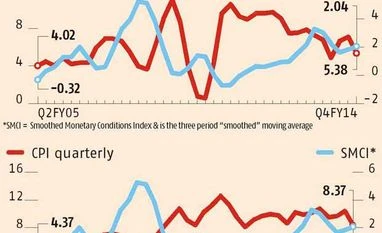
What are the key insights? Predictably, monetary conditions now are much tighter than in 2004-05 when the last economic boom gathered momentum. To the extent that monetary variables affect investment, the weather, thus, looks far less clement. Second, although the initial impetus to rising inflation might have come from a rise in food prices, its sustenance and transmission to generalised inflation came in an environment of extremely loose monetary conditions in 2010 and 2011. Thus, one could argue that RBI fell significantly behind the curve in quelling an inflationary build-up despite a series of repo rate hikes. In other words, the repo rate should have been raised even more aggressively. Going forward, given the fact that constraints remain for food supply and for a number of services like health care and education, we might not be able to afford much easier monetary conditions for a while.
Monetary conditions really tightened between early 2012 and the first quarter of 2013 (the index almost trebled in this period. This was, incidentally, a period in which the repo rate was (ironically enough) was actually cut. However, weak portfolio inflows that manifested in poor liquidity and weak stock markets coupled with a significantly overvalued exchange rate contributed to this tightening. There was a subsequent decline in the index partly driven by a correction in the exchange rate but it remains substantially higher than pre-2012 period. This should keep inflation in check.
Finally, the index highlights the fact that while episodes of disorderly and volatile depreciation might lead to temporary monetary easing, the expansionary effects are quickly offset by the rise in interest rates and the fall in stock markets that invariably goes with this. Thus, we are much better off with steady depreciation than a one-time correction in the currency if indeed it is used to improve monetary conditions
Rishi Shah is an economist with HDFC Bank.
Abheek Barua is with ICRIER
*(Kannan et al, 'RBI occasional papers, Winter 2006)

 "<b>Rishi Shah & Abheek Barua:</b> An old index, but new insights")


