Road to nowhere

Time for the Opposition to pull back on farm laws
FARMER PROTEST
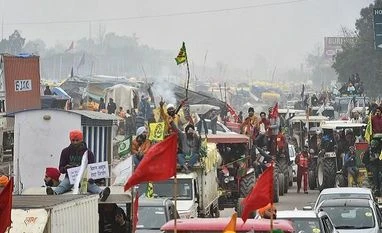
Farmers on the way to Tikri border during a tractor rally as part of their ongoing protest against the farm laws. Photo: PTI
Business Standard Editorial Comment New Delhi
3 min read Last Updated : Jan 11 2021 | 1:27 AM IST
Yet another round of talks between the Union government and protesting farmers remained inconclusive last week. Both sides will again meet on January 15. Meanwhile, the Supreme Court will hear on Monday the petitions challenging the new farm laws. On its part, the government has shown the willingness to address all issues and discuss the new agriculture laws, clause by clause. However, the protesting farmers do not want any such discussion and are demanding a complete withdrawal of the new laws — something that the government cannot and should not accept.

Clearly, the agitating farmers are overplaying their hand. There is nothing so wrong in the new farm laws to necessitate their repeal. The absolutism in the farmers’ demands is both silly and dangerous because Indian agriculture needs change and also a move away from the wheat-rice culture of Punjab and Haryana. Making the minimum support price (MSP) mandatory by law is asking for these crops to go the sugar way: Becoming outpriced, and impossible to export surpluses. As a matter of fact, it will also affect internal private trade and overall demand. Since the government cannot afford to buy more than what it is currently procuring, farmers would be left with surplus produce because price adjustment will become extremely difficult. A legal floor price will not allow markets to clear. Besides, this continued wheat-rice cycle with excessive use of water and chemicals in water-stressed areas will have longer-term irreparable environmental consequences. Inefficient cropping patterns can result in the desertification of these areas.

To be fair, farmers need income support and a safety net, but the fact is that most farmers in the country are already subject to market forces. According to estimates, less than 10 per cent farmers sell their produce at MSP. It is simply not possible for the government to extend the benefit of MSP to all farmers across the country. Also, it cannot promote unsustainable agriculture in a couple of states and burden the exchequer as well as the economy as a whole, merely because hordes have gathered around Delhi. The government may have bungled in its management of the issue, passing the laws without proper parliamentary discussion, but the opposition parties too must pull back now.

It is clear that the agriculture sector needs reforms. Among other things, it needs massive investment in managing output, which will have to come from the private sector. In this context, perhaps the opposition parties should explain how restrictions on maintaining the stock of agricultural produce benefited farmers over the years. Similarly, how providing a legal framework for contract farming will hurt farmers. In the case of MSP, the government has clearly said that there would be no policy change. In fact, the government needs to procure about 55 million tonnes of grains every year to fulfil its obligations under the National Food Security Act. Despite all its inefficiencies, it is unlikely that the MSP regime will be abandoned anytime soon. Thus, better sense must prevail on the underlying issues. There has to be a debate without coercive threats. Perhaps the most that the government can do is to hold the laws in abeyance and leave it to experts to pass judgement.


One subscription. Two world-class reads.

Already subscribed? Log in

Subscribe to read the full story →
*Subscribe to Business Standard digital and get complimentary access to The New York Times

Smart Quarterly

₹900

3 Months

₹300/Month

SAVE 25%

Smart Essential

₹2,700

1 Year

₹225/Month

SAVE 46%
*Complimentary New York Times access for the 2nd year will be given after 12 months

Super Saver

₹3,900

2 Years

₹162/Month

Subscribe

Renews automatically, cancel anytime

Here’s what’s included in our digital subscription plans

Exclusive premium stories online

  • Over 30 premium stories daily, handpicked by our editors

Complimentary Access to The New York Times

  • News, Games, Cooking, Audio, Wirecutter & The Athletic

Business Standard Epaper

  • Digital replica of our daily newspaper — with options to read, save, and share

Curated Newsletters

  • Insights on markets, finance, politics, tech, and more delivered to your inbox

Market Analysis & Investment Insights

  • In-depth market analysis & insights with access to The Smart Investor

Archives

  • Repository of articles and publications dating back to 1997

Ad-free Reading

  • Uninterrupted reading experience with no advertisements

Seamless Access Across All Devices

  • Access Business Standard across devices — mobile, tablet, or PC, via web or app

Topics :farmers' protestfarmersOpposition partiesagriculture sectorAgriculture reformminimum support priceAPMC mandis

Next Story



