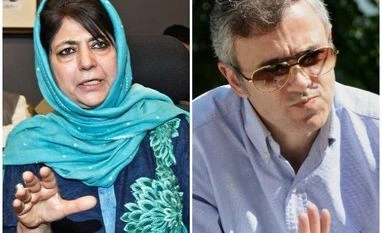
The Public Safety Act (PSA) dossiers against former Jammu & Kashmir (J&K) chief ministers Mehbooba Mufti and Omar Abdullah, who completed six months of house arrest, appear to have come straight from the playbook of the world’s most authoritarian regimes. The 42-year-old Act allows a person to be taken into custody to prevent him or her from acting in a “manner prejudicial to the security of the state and maintenance of public order” for up to two years. Even within that broad and ambiguous remit, the dossiers against Ms Mufti and Mr Abdullah are bizarre and thin on hard evidence. The accusations against the two leaders do not go beyond the standard activities of any politician in a vibrant democracy. For instance, Ms Mufti is inexplicably referred to as “Daddy’s girl” (is closeness to her late father a security threat?), who has “dangerous and insidious machinations and [a] usurping profile and nature”. The proof? Critical statements about the Centre’s decision to read down Article 370 and 35A, which gave the former state of J&K its special status. Apparently, Ms Mufti’s warning that the Centre’s actions would be “akin to lighting a powder keg” and tweets criticising the criminalisation of Triple Talaq — statements that commentators all over India have echoed — make her a threat to public safety.
It can be said that both leaders have been hoist with their own petard, since J&K governments have regularly invoked the Act since it was passed in 1978 as terror threats began to mount. But the evidence on which the Centre has chosen to act suggests an unwarrantedly thin-skinned response to criticism for its decision to alter J&K’s status. It is also worth noting that it has fully exercised a 2018 amendment to the PSA Act, allowing individuals to be detained outside the state. All these actions bear an unsettling resemblance to the British response to protests against the Rowlatt Act of 1919. The difference is that those repressions were imposed by a colonial power on a subject people. To be fair, it’s not the BJP alone; successive governments in India have been on an overdrive on preventive detention. Remember the Maintenance of Internal Security Act (MISA), a controversial law passed by Parliament in 1971? Sadly, the tradition continues. If citizens’ right to criticise a government becomes a law and order threat, the future of the republic as a functioning democracy becomes an open question.

 "Rowlatt redux?")












 Connect with us on WhatsApp