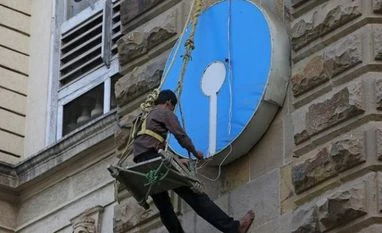
The first round of consolidation of public sector banks has been flagged off with the largest state-owned lender, State Bank of India (SBI), announcing its plans to merge its five subsidiaries and Bhartiya Mahila Bank (BMB) with itself. SBI has passed a resolution to seek government approval of the proposed merger.
The general consensus in the market is that the move will be value destructive for SBI in the short run, while the subsidiaries will gain from the merger.
The reason the merger is negative for SBI is that it would result in higher operational costs and would also burden the bank with the cost of redundancies and overlapping. SBI chairman Arundhati Bhattacharya is reported to have said that the superannuation cost of the merger will be an incremental Rs 23 crore per month.
When SBI merged two of its subsidiaries -- State Bank of Indore in 2010 and State Bank of Saurashtra in 2008 -- the losses on account of the amalgamation were Rs 8,900 crore and Rs 6,100 crore . It is now merging its five subsidiaries, which is expected to cost even more. SBI clearly is not in the best of health to absorb such losses, given the write-offs it has had to deal with over the past few quarters, with some more to follow, going forward.
The merger however, seems to have been conceived to support the subsidiaries instead of benefitting SBI. At a time when private sector banks are becoming more aggressive, smaller public sector banks will be finding it difficult to stand up on their own. Many smaller PSBs are yet to grapple with the latest technological sector changes taking place. With human interface in banking decreasing, the smaller banks would have to make a big leap to stay in the same league as some of the private banks.
SBI, on the other hand has been keeping in step, at least in terms of technology, with its private sector peers. Sharing the same technology platform would not only reduce the cost for the smaller banks but will also integrate them with the parent bank operationally.
For SBI too, the short term pain notwithstanding, there are advantages in the merger. The merger will result in SBI's consolidated balance sheet size increasing by 32 per cent to Rs 37 lakh crore from Rs 28 lakh crore currently. Bank rationalisation and ATM penetration will help increase its presence.
The merger will make SBI nearly five times bigger than its immediate competitor, ICICI Bank, in terms of balance sheet size. Does this merger then make SBI a bank which will be too big to fail?
Generally banks in India are not allowed to fail, unless they are co-operative entities or very aggressive private sector banks such as Global Trust Bank. Even United Bank, which posted nearly 15 per cent of its assets as non-performing, has been kept on the ventilator by the government. In fact, the government recently funded the bank by putting in more money through the preferential rule. National banks, irrespective of the size, are sacred cows that cannot fail.
Unlike banks in developed countries, Indian banks do not deal with exotic derivative products that have the potential of wiping them off. Further, the buffer and statutory reserves that RBI asks banks to maintain with it also ensure protection. In the current scenario, public sector banks have been reporting huge losses on account of non-performing assets; many have been hit on the tier-I capital. Government has ensured that it will be capitalising the banks to the extent of the damage.
The rationale behind SBI and the government’s move to merge its subsidiary seems to be ‘too small to survive’ rather than ‘too big to fail’.
A fast growing economy like India needs bigger banks to fund the bigger projects that will be undertaken in future. Currently, these projects have to rely on consortium funding from longer-term players such as insurance and pension funds. Bigger banks are the need of the hour. For SBI, though there would be short-term pains, its balance sheet size will ensure that it would be able to fund bigger projects.

 "SBI subsidiaries merger: a case of 'too small to survive on your own'")

