Shekhar Gupta: There is something in the air

It isn't what you think. Political winds haven't shifted yet. But the air is thick with doubts, economic stress is hurting and for the first time since his rise in 2013, the PM is fighting back
Politics
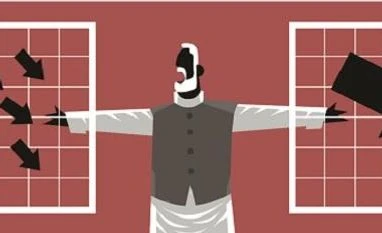
Illustration by Binay Sinha
Shekhar Gupta
Last Updated : Oct 06 2017 | 11:05 PM IST
There is a new pattern to how conversations often begin these days, particularly if prominent members of the entrepreneurial community are present. Someone usually beckons you to a more private corner and begins:

“Can I ask you a question off the record?”

“I am a journalist, I am never off the record, sir. So please ask me anything on the record,” I would say.

“No, that is ok, but it is a very sensitive question, so off the record please,” the interlocutor pleads.

“Sir, I have nothing to say off the record. People might sometimes speak off the record with a journalist, a journalist has no need to do so.”

It can go on for a bit on these lines and then the deadlock is broken by the person telling you, with a sheepish dread, that it is he who wants to be off the record. He doesn’t want anybody to know he asked this question. That word given, comes the question:

“Aap kya sochtey hain, kuchh hawa badal rahi hai? (Now, what do you think? Are the winds shifting?)

The reference is to the popularity of Prime Minister Narendra Modi. I answer it with utmost honesty, and so I am writing it here on the record, with a simple “I don’t think so”. What you are hearing is usual mid-term noise. But there is, finally, some noise although it’s well past the mid-term point in this government.

If such a conversation came up again over this weekend, my response, however, may be somewhat clearer. I might still say I don’t think the winds are shifting yet, but there is something in the air — something we haven’t sniffed since the electoral catharsis after the bitter years of UPA-2, its pessimism, and doubts.

The new doubts and some pessimism come from a growing unease over the state of the economy. The stall may have begun during the last two years of the UPA, but has now gone on for too long. Six quarters of consecutive GDP decline, two 1,100-volt jolts (demonetisation and the goods and services tax), job losses, and wage freezes (except in the government with the Seventh Pay Commission) are beginning to hurt.

Most people may not care for the finer points of RBI reports, monetary policy, GDP, current account deficit, balance of trade, real interest rates, and other such exotic jargon. But the pain of somebody in the family losing her job, or not being able to get one, or the frustration of forced under-employment at the family mithai shop hurts. It also hurts if demonetisation punched a six-month hole in the output of your tiny bangle-making business. Having to wrestle with the intricacies of the GST now is just that much salt over the wounds. The Prime Minister’s popularity remains formidable. If there was an election now, it doesn’t seem the result will still be radically different from the one of 2014 or even what the last India Today ‘Mood of the Nation Poll’ (August 2017, 349 Lok Sabha seats for the NDA) showed. But three things can be said for sure. The faithful have suffered for too long and doubts have begun to assail their minds. The Prime Minister is not in decline as most incumbents are expected to be at the two-thirds point of their tenure. But his ascent has stalled. Politics can’t stay frozen for nearly two years until the next polls.

Illustration by Binay Sinha
Concern was visible in the Prime Minister’s spirited, hour-long speech to the gathering of company secretaries this week, hours after the RBI had lowered this year’s growth estimates further and denied the government the steroidal breather of a rate cut. The speech was vintage Modi. All fire, fury, ferocity, and confidence. But, for the first time since 2013, he was fighting back. Combative for sure, but on the defensive. You could read it in his repeated comparison of his three years in power to the Congress party’s last two, which were so bad that it was reduced to 44 in the Lok Sabha. I bet his supporters went home all fired up again, such is his magic with words and so magisterial his sway over public opinion. But worry showed on his face.

It also shows in many of his recent actions. His attack on those “spreading pessimism” was prickly, and of a piece with Indira Gandhi’s condemnation on those “creating cynicism” in her crisis months and former US Vice-President Spiro Agnew’s fabled flourish of “nattering nabobs of negativism”. The return of the Economic Advisory Council he had dismantled earlier was the first rollback of an idea. Within months of pouring scorn over Harvard-educated economists he has now drafted one at least from Princeton (Surjit Bhalla) in this council. The second was the rollback of the excise duty on petrol and diesel, weeks after senior ministers had aggressively defended these as most necessary to raise resources for development. The new tourism minister was so bold (this isn’t sarcasm, I agree with him) as to remind the whining middle classes that those owning motor-vehicles should stop complaining about taxes. Now, BJP leaders are tweeting to thank the Prime Minister for this “pro-poor” step. The finance minister has said he will write to chief ministers to cut their VAT. Between these two blinks came RSS chief Mohan Bhagwat’s “state of the union” address on Dussehra, expressing concern over jobs, prices, traders, and economic distress. This is unusual when the BJP is in power.

The government draws comfort from the state of the opposition, its lack of a leader to match the Prime Minister’s appeal, energy and focus, or a common agenda. But as we know, a most popular leader can also suffer a decline if people get so angry that they vote against him, never mind the rival. That’s how Rajiv Gandhi lost despite his much larger majority in the Lok Sabha than Modi’s now. 

That tipping point looks quite far yet. But there are interesting straws in this wind. Among the first indications of trouble for a leader is the appearance and popularity of inspired jokes, and in these times funny memes. About the Modi government, that started about six months ago and has gathered momentum. Second, however broken the opposition may be, it has cracked the science of social media warfare. The BJP used it brilliantly to demolish the Congress and allies. Now it doesn’t look so one-sided.
In fact, the balance of firepower in this electronic warfare is shifting. The Aam Aadmi Party has always been good at this, the Congress has learnt it, and the very articulate and well-networked community of what The Economist described this week as India’s “lingering Left-liberal elite” has added its might, and the BJP has competition. The BJP had put itself at a great advantage by controlling the message. That control is now fraying.

The Prime Minister put his oratorical best foot forward this week. He has no competition there. But at this likely inflexion point, just this won’t be enough. Too much energy these three years has been invested in turning the party into an election-winning machine. Governance needs greater attention, ironically just when important state elections come closer. If the government doesn’t revive its waning momentum, a slide can be lurking. Just changing the message won’t do. To recover its mojo, the Modi government needs a more impressive set of economic figures to flaunt — and of its own tenure, not from the UPA’s past.

By special arrangement with ThePrint

One subscription. Two world-class reads.

Already subscribed? Log in

Subscribe to read the full story →
*Subscribe to Business Standard digital and get complimentary access to The New York Times

Smart Quarterly

₹900

3 Months

₹300/Month

SAVE 25%

Smart Essential

₹2,700

1 Year

₹225/Month

SAVE 46%
*Complimentary New York Times access for the 2nd year will be given after 12 months

Super Saver

₹3,900

2 Years

₹162/Month

Subscribe

Renews automatically, cancel anytime

Here’s what’s included in our digital subscription plans

Exclusive premium stories online

  • Over 30 premium stories daily, handpicked by our editors

Complimentary Access to The New York Times

  • News, Games, Cooking, Audio, Wirecutter & The Athletic

Business Standard Epaper

  • Digital replica of our daily newspaper — with options to read, save, and share

Curated Newsletters

  • Insights on markets, finance, politics, tech, and more delivered to your inbox

Market Analysis & Investment Insights

  • In-depth market analysis & insights with access to The Smart Investor

Archives

  • Repository of articles and publications dating back to 1997

Ad-free Reading

  • Uninterrupted reading experience with no advertisements

Seamless Access Across All Devices

  • Access Business Standard across devices — mobile, tablet, or PC, via web or app

More From This Section

Disclaimer: These are personal views of the writer. They do not necessarily reflect the opinion of www.business-standard.com or the Business Standard newspaper
Next Story



