Home / Opinion / Columns / Vinayak Chatterjee: Water 'treaty' between states
Vinayak Chatterjee: Water 'treaty' between states
There is a need to have constitutionally valid agreements on river water-sharing
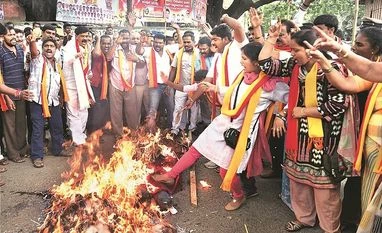
Burning Problem: Protesters burn effigies of Tamil Nadu CM J Jayalalithaa in Bengaluru earlier this year. Conflicts between states over water are escalating and getting uglier with the ever-present danger of massive civil unrest
A “treaty” between states on river-water sharing is not a new idea. Way back in 1924, in British India, a treaty was signed between the Madras Presidency and the princely state of Mysore over sharing Cauvery waters. In 1974, Karnataka cancelled the 1924 treaty.
The Indus Water Treaty is a water distribution accord between India and Pakistan (brokered by the World Bank) and signed in 1960. It is one of the most significant water-sharing agreements in the world, even surviving multiple wars between the two countries and many phases of political stand-offs. The treaty established the Permanent Indus Commission to deal with disputes through well-established international arbitration processes. The commission was also tasked with regular inspections and data-sharing.
In the South Asian region, India, Pakistan, Bangladesh, Nepal and Bhutan all depend on rivers originating in and passing through foreign territory. Luckily, there is in place a fairly robust framework of treaties, accords and agreements between India and its other neighbours — Bangladesh, Nepal and Bhutan. Though issues arise from time to time (Teesta with Bangladesh, hydro-projects and floods with Nepal), they are all addressed within a pre-set framework that prevents flashpoints. India and China established an Expert Level Mechanism on trans-border rivers, and in October 2013 the two governments signed a memorandum of understanding on strengthening cooperation under which Beijing provides data to India on the water flows.
Surely a similar model of “ex-ante” agreement enshrined in a “treaty” could be made to work among the states in India. This is a requirement whose time has come as conflicts between states over water are escalating and getting uglier with the ever-present danger of massive civil unrest. There is also the phenomenon of “upper riparian chauvinism” whereby residents of upstream geographies assume a natural authority to control the resources flowing downstream. Today, river water disputes in India have moved away from water per se, to larger issues encompassing legislature-judiciary conflicts, political posturing and debates on conflicting urban-rural claims. There is historical evidence that conflicts over entitlement of natural resources and related economics, if not resolved, can lead to serious ethnic conflicts. Clearly, such a tinderbox cannot be allowed to remain unattended with the dangerous possibilities of conflagration any time.
Interstate water disputes are different from other interstate disputes. The Constitution, under Article 262, bars the jurisdiction of the Supreme Court or any other court over interstate water disputes. The Inter-State River Water Disputes (ISRWD) Act, 1956, however, provides a mechanism for the resolution of disputes. Under its provisions, disputes are to be adjudicated by ad hoc, temporary and exclusive tribunals. The tribunals are dissolved after they deliver their awards. The awards carry the force of a Supreme Court decree, and are binding on the states for a period of 25 to 30 years.
Unfortunately, of the eight interstate water dispute tribunals set up under the ISRWD Act so far only three disputes filed in 1969 could be resolved. All others remain pending and sub-judice. In the process, some lessons have been learnt.
Burning Problem: Protesters burn effigies of Tamil Nadu CM J Jayalalithaa in Bengaluru earlier this year. Conflicts between states over water are escalating and getting uglier with the ever-present danger of massive civil unrest
The system is an ex-post one. It kicks in only when a dispute arises. A long time is taken to constitute tribunals. There are inadequate systems in place among government institutions to assess demand and supply reasonably accurately. After an award is given, there are problems of interpretation and implementation. There is no mechanism to enforce the binding character of such awards. The Centre has not been able to act decisively as it is predominantly a state subject. The tribunals continue for an inordinately long time and for one reason or the other, decisions are not taken. Pronouncements of interim awards have led to further complications. Increasingly, states are becoming resistant to complying with awards of tribunals in spite of express provisions in the Constitution regarding the finality of such awards. Courts are barred from reviewing the awards of the tribunals, but matters are still taken to the Supreme Court on related issues.
The net result is that there has not been a final settlement on any interstate river water dispute since 1980. Extraneous factors are also aggravating the issue.
Climate change and global warming are leading to shifting rainfall patterns. Water allocations in monsoon-deficit years are emerging as the most contentious issue between states. There has not been any instance of satisfactory and successful distress-sharing practices. There are varying interpretations of property rights, both of water itself and its management, across various capital-intensive installations in irrigation, hydro-electricity and storage/distribution. Finally, there is a view that this is a technical matter not to be decided by judges in a court of law but by experts on hydrology and water management.
The moves underway now for a massive “river-linking” programme also raise a host of fresh issues between states. Thirty inter-basin transfers — through a proposed network of canals, dams, aquaducts and pumping stations have been estimated by the water resources ministry in April 2016 to require a capital outlay of Rs 11 lakh crore. To get its arms around all this, the Centre has brought in the final draft of the National Water Framework Bill, 2016. The draft Bill pitches for establishing a River Basin Authority for each interstate basin to ensure optimum and sustainable development of rivers and valleys. The draft Bill is expected to be placed before the Union Cabinet for its approval shortly.
Co-operative federalism, enshrined in ex-ante river-water treaties, needs serious consideration.
The author is chairman, Feedback Infra. vinayak.chatterjee@feedbackinfra.com; Twitter: @Infra_VinayakCh
Disclaimer: These are personal views of the writer. They do not necessarily reflect the opinion of www.business-standard.com or the Business Standard newspaper

 "<b>Vinayak Chatterjee: </b> Water 'treaty' between states")


 Connect with us on WhatsApp