At this fraught, somewhat juvenile moment in India’s political history, when the president of the principal opposition party has declared in effect that the prime minister is corrupt, and in response the entire Union Cabinet has been ordered to tweet a hashtag that his entire family are thieves, it might be useful to look back at two points in our recent history. First, 2011; and second, 2008.
It is odd how distant the concerns of 2011 seem. Does anyone remember that the entire nation — or, at any rate, every television channel — came to a stop, demanding a Lok Pal who would serve as an ombudsman for corruption allegations at the highest level? Editorials were written, statements were delivered, dining-table conversations insisted that without a Lok Pal there was no accountability. It was considered a matter of such urgency that a Bill had to be passed practically in the middle of the night to ensure it; Union ministers besmirched their office by meeting motivated activists of various stripes; and so on.
This may come as a surprise to many readers, but we don’t have a Lok Pal yet. Oh, of course, the relevant legislation has been passed and notified — by, as it happens, the last government. This government, however, has not seen fit to appoint a Lok Pal. Yet there are no murmurings of disquiet. There is no anger. Could it be, perhaps, that there was something quite artificial about that movement? Certainly, in retrospect, given the suspicious silence at the moment, it is hard to argue otherwise.
Illustration: Ajay Mohanty
Which brings us to the second date to consider: 2008. The United Progressive Alliance at that point was a year away from re-election, and broadly dominant politically. At the same time, telecom licences were being handed out, the Commonwealth Games were being organised, coal mines allocated — you get my drift. At that point was there a perception that the government was corrupt? No, as a matter of fact there was not. The perception did not develop until those decisions were revealed, excavated, and analysed. In 2018, as the National Democratic Alliance is a year away from probably being re-elected, and is broadly dominant politically, what decisions has it taken or is it taking that are problematic? Are they being revealed, excavated and analysed as the UPA’s were? Can they be? These are the questions we should be asking.
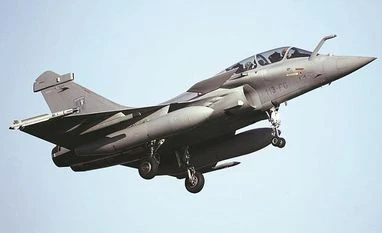
It is entirely possible that there was, in fact, no “scam” in the Rafale deal. Certainly, I believe that sufficiently powerful evidence of one has not yet emerged. Yet the government could indeed go on the front foot not through puerile hashtags but instead through explaining its motivations clearly, giving the maximum possible information about pricing and providing additional transparency about its offsets mechanism and the choice of private sector partners. Elementary mistakes like confusing two companies named Reliance — a mistake made by senior Union ministers in public — should be avoided, because it can come across as seeking to deliberately obscure the truth. And shoving all the blame and responsibility on to Dassault while also implying a former French president is conspiring with the opposition is only going to raise more eyebrows. As it stands, the government is undermining its own claim to have controlled corruption, even though the Opposition has failed to prove its claim about corruption in aircraft procurement.

 "Lack of transparency belies Modi govt's claim of corruption-free governance")












 Connect with us on WhatsApp