Bet on a consistent performer as fund manager for NPS

With returns of funds diverging in the current active fund management regime of NPS, opt for a fund manager whose performance has been steady over the long term
Chart
.
Sanjay Kumar Singh New Delhi
Last Updated : Oct 13 2017 | 12:09 AM IST
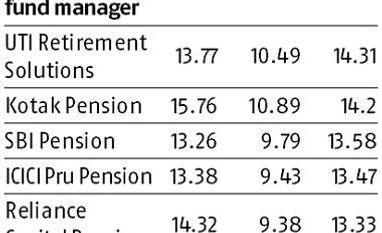
It has been over two years since active fund management was allowed in the National Pension System (NPS) for the private sector. With active fund management, returns of funds have begun to diverge from one another. Over the past one year, returns of tier-1 equity funds are in the range of 13.11-16.93 per cent. In the case of government bond funds, returns are in the range of 4.52-7.17 per cent. In the case of corporate debt funds, the variation in returns is lower: 7.14-7.86 per cent.

Earlier, when these funds were managed passively, it did not matter which fund manager you chose since returns were similar. But now, investors need to monitor the performance of various pension fund managers (PFMs) closely and make a choice, as even a 100-basis point higher return over a 30-35-year span can make a considerable difference to the final corpus due to compounding effect.

In NPS, investors have to keep in mind one constraint: All their three funds — equity, corporate debt and government debt — have to be chosen from the same PFM. They don't have the luxury of selecting the best-performing funds of three different PFMs. 

While choosing a PFM, investors need to take into consideration their allocation across the three asset classes. If they have exposure to equities, they should select a PFM whose equity fund is doing well. "This is where one is likely to see high variation in returns. The impact on the investor's final return will also be greater if he is able to choose the right equity fund," says Mumbai-based financial planner Arnav Pandya. In case of an investor who is exposed only to debt funds, he may calculate the weighted average return for the corporate and government bond funds of various PFMs (based on his asset allocation to these two types of funds) and then make a choice. 

Keep a few things in mind while selecting the equity fund. One, while historical returns can't be ignored, they are also no guarantee of future performance. One may find that one PFM outperforms in a market that is moving up, while another does a better job of containing downside risk in a declining market. So, chasing yesterday's best performer may not be a very wise idea. "If a fund manager has filled his portfolio with high-beta stocks, he may do well amid momentum but will perform poorly in a market that is conducive to low-beta stocks," says Anil Rego, chief executive officer, Right Horizons, a Bengaluru-based financial planning firm. He suggests that investors should give higher priority to a PFM whose performance has been stable across various time horizons. Such a PFM is also likely to have taken less risk.  
 
Investors should also give higher weight to longer-term returns. "One fund manager may have given a return of 20 per cent over the past one year while another may have given a 15 per cent compounded annual return over five years. Prefer the latter. Maintaining good return over five years is a far tougher job than being top performer for a year," says Rego. 

Investors who have already invested with a PFM should not shift just because their fund has underperformed another by a small margin. Only if the funds managed by a PFM consistently underperform their benchmark should a shift be considered. 

For most investors, returns of the equity fund will be important when they are younger while debt funds will become more important as they approach retirement. Finally, review the performance of your PFM once at least every couple of years and switch if he has been a laggard. 

One subscription. Two world-class reads.

Already subscribed? Log in

Subscribe to read the full story →
*Subscribe to Business Standard digital and get complimentary access to The New York Times

Smart Quarterly

₹900

3 Months

₹300/Month

SAVE 25%

Smart Essential

₹2,700

1 Year

₹225/Month

SAVE 46%
*Complimentary New York Times access for the 2nd year will be given after 12 months

Super Saver

₹3,900

2 Years

₹162/Month

Subscribe

Renews automatically, cancel anytime

Here’s what’s included in our digital subscription plans

Exclusive premium stories online

  • Over 30 premium stories daily, handpicked by our editors

Complimentary Access to The New York Times

  • News, Games, Cooking, Audio, Wirecutter & The Athletic

Business Standard Epaper

  • Digital replica of our daily newspaper — with options to read, save, and share

Curated Newsletters

  • Insights on markets, finance, politics, tech, and more delivered to your inbox

Market Analysis & Investment Insights

  • In-depth market analysis & insights with access to The Smart Investor

Archives

  • Repository of articles and publications dating back to 1997

Ad-free Reading

  • Uninterrupted reading experience with no advertisements

Seamless Access Across All Devices

  • Access Business Standard across devices — mobile, tablet, or PC, via web or app

Next Story



