What would you choose if you have an option to buy a house in India worth Rs 1 crore that gets you an annual rent of 2-3 per cent of the property value or one in Manchester that earns a rent of 8-10 per cent?
The deal on the international property can further sweeten if you are taking a loan. For a property in India, you get a rupee loan at minimum 8.4 per cent. In Manchester, the loan in British pound can be availed at 2-2.5 per cent. In other words, even after paying the equated monthly instalment to the foreign bank, you will earn a good 5 per cent or more — still higher than any residential property yield in India.
Obviously, the affluent and high net worth individuals are seeing many good opportunities abroad. “It’s not just affluent that are looking for real estate abroad. We are getting queries even from upper middle-class families,” says Mona Jalota, director-international and NRI, residential services, Colliers International India. She points out that for investment, there are opportunities starting at even Rs 35 lakh in places like Pattaya, Thailand. Comparatively, an individual will need to shell out around Rs 60 lakh to get a one-bedroom-hall-kitchen in the popular tourist destination like Goa.
Financially, it’s easier now: In May 2016, the Reserve Bank of India hiked the money Indians can remit outside the country to $250,000 a year. It was $75,000 and $125,000 in 2013 and 2014 respectively. A family of four can now send up to $1 million a year. “The lower limit earlier was the main reason deterring investors from purchasing property abroad, as investors would have had to wait for several years to arrange for funds equivalent to the value of the property. The subsequent increase gave impetus for the acquisition of immovable properties abroad by providing enough headroom to the investors to accumulate funds within a financial year for financing the purchase,” says Samantak Das, chief economist & national director-research, Knight Frank India. The money remitted to buy property is on the rise. In 2014-15, Indians remitted $45.4 million, it rose to $88.4 million in 2015-16, and in 2016-17 it went up to $111.9 million.
Reasons to buy: While investment is the top priority, many are also looking international property as a second home, according to a report from Knight Frank. Many even buy property in countries where their children are studying. Many countries also grant permanent residency if an individual invests in property beyond a certain limit. “In India, the focus of most developers have shifted to affordable housing. Many individuals would not prefer to invest in this segment and would rather prefer to invest internationally,” says Siddhart Goel, senior director, research services, Cushman & Wakefield India.
Many foreign property markets are more transparent than the domestic market. “Investors can get ‘clean’ deals much faster and easier,” says Anuj Puri, chairman, Anarock Property Consultants. He points out that Singapore, Malaysia, New York, Dubai and various cities in the UK — predominantly London — are the preferred destinations for Indian property buyers. “The key to successful investment in all these markets is higher risk appetite coupled with a sufficiently long investment horizon,” says Puri.
The Knight Frank report also states that most prefer to buy apartments as compared to villas or duplexes. It also means that the preferred property size is smaller (less than 1,500 square feet) and so is the ticket size (less than $1 million).
Plan it right: International property purchase involves rules, regulations and taxation in two countries. It, therefore, helps to approach an international property consultant that has offices in India and offers advisory services on buying property overseas. Based on your needs, they can tell you the best location, offer properties from developers with a track record, help with the paperwork in India and abroad and explain the regulation and taxes. “But an individual should only invest after familiarising himself with the market,” suggests Goel.
If you want to diversify your international investments, for example, they can even help you with projects that have fractional ownership. Also, while the Reserve Bank of India says that you cannot borrow from an Indian bank to buy property abroad, there’s more clarity needed on whether an individual can borrow abroad. If a buyer wants to avail mortgage, he will need guidance on the loan structure.
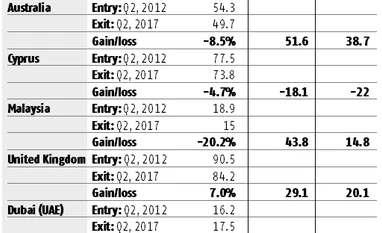
Currency movement matters: The appreciation of rupee can eat into your returns and vice versa. If a buyer had purchased property in Australia five years back (end of second quarter of the financial year), he would have lost 8.5 per cent due to a stronger rupee, according to Knight Frank report. But he would still stand to benefit as property prices increased over 50 per cent.
As rupee has gained against many currencies in the past one year, for investors investing in the United Kingdom, Cyprus, Malaysia, and Dubai, it would be cheaper to buy a property now compared to a year earlier if you only consider the exchange rates. But you will also need to see the appreciation in property prices in this period. In Australia, for example, the quantum of increase in property prices has surpassed the strengthening of the rupee. Investing in property in Australia is expensive now compared to a year earlier if one considers currency exchange and property price movement.
Taxation can be cumbersome: While there’s no taxation at the time of investment, the complexities may arise later. These may include obtaining tax registrations, filing tax returns, payment of property taxes, etc. Some countries also levy withholding tax on rental payments. Buyers would need to abide by tax laws in two countries. “Under the Indian tax laws, a resident or an ordinarily resident of India is taxed on her worldwide income. This includes capital gains, rental income and income from other sources,” says Suraj Nangia, partner, Nangia & Co. He also adds that a person would need to maintain books of investments, bank accounts’ statements, documents of payments and property papers for 16 years from the assessment years.
Just like the RBI restricts remittances, the country where the property is located, too, may have similar regulations. When a person sells a property, he may not be able to bring all the funds to India at one go.