Should you invest in credit opportunity funds?
Before you rush out to put in your money, understand the risks they carry
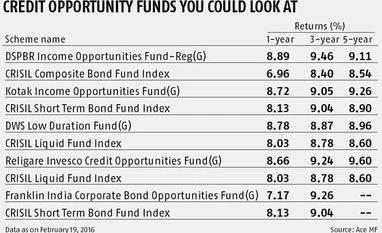
Sanjay Kumar Singh The one-year category average return of credit opportunity funds is currently the highest among all mutual fund categories at 8.70 per cent (as on February 16, maximum 9.69 per cent and minimum 6.49 per cent), according to the mutual fund rating agency Value Research. This has no doubt been aided by the downturn in equities, and the fact that interest rates have not declined significantly over the past year, so duration-oriented funds have not outperformed. Before investors rush out to invest in credit opportunity funds for their returns, they should understand how these funds work and the risks they carry.
In a credit opportunity fund, the fund manager includes lower-rated paper with the expectation of garnering higher returns. A debt instrument that is rated lower than AA may be looked upon as risky. However, according to Renu Pothen, research head, fundsupermart.com, "Ratings should not be treated as sacrosanct. If the fund management team has done its work and is convinced about the instrument, it may add the bond to its portfolio." Fund managers also bet on lower-rated paper in anticipation of an upgrade in rating, which boosts its price.
Experts, however, warn that credit opportunity funds stand at the very top of the pyramid in terms of risk. There can be situations when the lower-rated paper in these funds is downgraded. "Only investors who understand credit risk and don't get nervous every time a bond is downgraded should bet on these funds," says Pothen. Downgrades and upgrades are a regular feature of these funds and a downgrade should not be confused with a default, she adds. If a bond is downgraded below investment grade, that is a cause for concern, however. "Keep the fund on your radar, and don't take fresh exposure in it till you have some clarity from the fund house on the instrument," says Pothen. Investors who believe their fixed-income portfolios should be entirely free of risk should avoid these funds.
Credit opportunity funds also carry higher liquidity risk. Liquidity tends to be low in lower-rated corporate bonds. "If a lower-rated bond is downgraded or defaults, the fund manager will find it difficult to exit his position," says Vishal Dhawan, chief financial planner, Plan Ahead Wealth Advisors.
When designing your fixed-income portfolio, invest in a range of products carrying different levels of risk and return potential. In one basket, have safe, hold-to-maturity products such as tax-free bonds and bank fixed deposits. In the second basket, keep products that benefit from declining interest rates, such as dynamic bond funds and duration funds. And in the third basket, have funds that play on credit risk.
Avoid taking credit-related bets on your own, especially in significant quantities. It is better to make these bets via mutual funds, which are well diversified.
When choosing a fund from this category, prefer larger-sized funds whose bigger corpus allows them to diversify properly. Opt for a fund with a lower expense ratio. Make sure that the fund manager has considerable experience in managing credit risk. Also ensure that the fund's portfolio is not too concentrated in a particular group's securities. Depending on your risk appetite, you may invest 10-25 per cent of your fixed-income portfolio in these funds.

 "Should you invest in credit opportunity funds?")


 Connect with us on WhatsApp