Transferring home loan balance can be tricky: All you need to know

It's not just interest rate difference that matters. There are other sundry costs, and the timing is important
Graph
Joydeep GhoshSanjay Kumar Singh
Last Updated : Jul 22 2018 | 9:27 PM IST
Deepak Parekh, chairman of India's biggest housing finance company, Housing Development Finance Corporation (HDFC), recently lamented that poaching of customers by lenders had significantly increased the turnover rate within the industry. And he is right. Poaching customers has become a big business.  

Most customers are used to multiple calls from telemarketers of lenders who claim to offer significantly better rates, and sometimes, it may make sense to shift. But you need to do the numbers carefully, especially when you are shifting a long-term loan like a housing loan because you will see both sides of the interest rate cycle during the loan period. Also, there is a refinancing cost of 1-2 per cent and other costs that might offset the benefits from shifting. Let’s look at situations when it does make sense to do so.         

Interest rate difference should be significant: Home loan borrowers should opt for a home loan balance transfer if the interest rate charged by the new lender leads to a significant saving in interest cost. “This will be especially helpful in the current rising interest regime as a balance transfer will help the borrower reduce his interest cost. He can thus prevent his disposable income from being affected by rising interest rates. He can also continue with the investments that he currently makes,” says Naveen Kukreja, chief executive officer and co-founder, Paisabazaar.com. 

But what is a good difference? “Home loan refinancing should be carefully thought about as the interest rate is a moving target. One should consider changing it only when there is a significant difference like say 100 basis points or more. Only then the savings will be worthwhile to go through the motions of all the new paperwork and additional efforts. Also, in the Indian situation, most people like to prepay the loan as soon as possible.

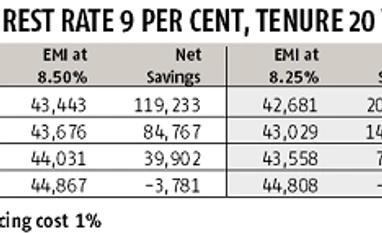
In such an accelerated reduction in loan situation, one needs to find out again whether switching the loan is a good idea or not,” says financial planner Suresh Sadagopan. For example: If you have taken a Rs 5 million loan at a floating rate of 9 per cent for 20 years, the equated monthly instalment (EMI) will be Rs 44,986. Now if another bank is offering at 8.5 per cent after the first year, and if you shift, the new EMI will be Rs  43,433 — a difference of Rs 1,533. The net savings after 20 years will be Rs 119, 233 (after incurring a refinancing cost of Rs 49,064). This is a decent saving and could make sense. 

Timing, processing fees are extremely important: While shifting the loan after one year could make sense in most cases, things could be completely different if you are shifting in the later years. So, if the same loan is transferred to another bank at 8.5 per cent in year 10, the net saving is just Rs 39,902 — not a significant one (See table). And this benefit keeps on falling over the years.

However, as the rate difference increases, the benefits increase as well. For example: If you shift to 8 per cent after the first year, you will stand to gain Rs 284,818 over the entire loan period. However, in the last few years, the benefit would be as low as Rs 6,467. And that is primarily because of the refinance cost of one per cent. So if you wish to shift, look for a lender with low refinance or procession fees. “The processing fee that the latter charges should not exceed Rs 2,500-5,000,” says Rishi Mehra, CEO, Wishfin.com.  

There could be other charges as well: Besides the processing fee, lenders levy a number of other charges, such as administrative charge, stamp duty, legal charges, valuation fee, technical charges, and so on. All of them can together amount to Rs 10,000-25,000 or even more.

Find out upfront how much the new lender will charge from you. Some lenders also impose certain preconditions on borrowers, such as coercing them into buying an insurance policy. Make sure that your lender will not make any such request. At the time of balance transfer, the new lender may offer to increase your tenure and reduce your EMI. “Unless you are having problems in paying the EMI, you should avoid this option. If you increase the loan tenure, your total interest outgo will rise,” says Mehra.

One subscription. Two world-class reads.

Already subscribed? Log in

Subscribe to read the full story →
*Subscribe to Business Standard digital and get complimentary access to The New York Times

Smart Quarterly

₹900

3 Months

₹300/Month

SAVE 25%

Smart Essential

₹2,700

1 Year

₹225/Month

SAVE 46%
*Complimentary New York Times access for the 2nd year will be given after 12 months

Super Saver

₹3,900

2 Years

₹162/Month

Subscribe

Renews automatically, cancel anytime

Here’s what’s included in our digital subscription plans

Exclusive premium stories online

  • Over 30 premium stories daily, handpicked by our editors

Complimentary Access to The New York Times

  • News, Games, Cooking, Audio, Wirecutter & The Athletic

Business Standard Epaper

  • Digital replica of our daily newspaper — with options to read, save, and share

Curated Newsletters

  • Insights on markets, finance, politics, tech, and more delivered to your inbox

Market Analysis & Investment Insights

  • In-depth market analysis & insights with access to The Smart Investor

Archives

  • Repository of articles and publications dating back to 1997

Ad-free Reading

  • Uninterrupted reading experience with no advertisements

Seamless Access Across All Devices

  • Access Business Standard across devices — mobile, tablet, or PC, via web or app

Next Story



