Last year, Rahul Sharma, an employee with a reputed fast-moving consumer goods (FMCG) company, realised the importance of paperwork and timely submission of investment documents to his employer when he received a fifth of his monthly salary. This year, he was relaxed when he got the official e-mail from his payroll department for investment papers and other tax-related documents before January 20. However, without reading the e-mail carefully, he gave copies of his investment documents against the declaration submitted at the beginning of the year. Unfortunately, he missed out on the newly-introduced requirement of making such claims in the prescribed Form 12BB. He again got a shock when he discovered that his January salary was lower than what it should have been. When he called the personnel concerned, the latter rattled off his mistakes: Not submitting Form 12BB for claims like house rent allowance (HRA), leave travel assistance (LTA) and interest on the housing loan. Once again, Sharma had to make amends by filling up the required form and providing the missing documents. Like Rahul, you too could face similar problems if you fail to give investment documents to your employer with Form 12BB.
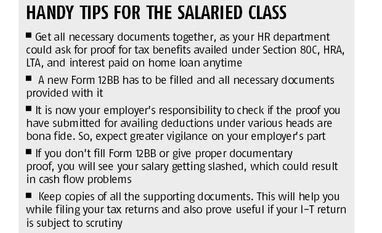
Introduction of new form With the change in law and introduction of this form (12BB), all claims like LTA, HRA, Section 80C investments, and interest on home loans have been put under tight scrutiny by employers, as they have the obligation to obtain, assess and verify the necessary evidence for the claims filed by employees for enjoying various deductions. Earlier, in the absence of a standard process and form, different employers followed different approaches. Some even relied on self-declaration made by employees.
This form has been introduced in the current financial year and became applicable from June 1, 2016. It has to be filled, self-certified and submitted to the employer. This is a significant change from last year. Any attempt by employees to self-verify a false declaration or inaccurate particulars may attract penal consequences under the Income-Tax Act.
Pay heed to paperwork In the current scenario, employees should take the required paperwork seriously to avoid higher deduction of taxes. The changes to the rules also enhance the risk of selection of the filed return for scrutiny or verification by the tax authorities. You also need to be diligent to avoid an adverse cash flow situation in the final months of the year.
Let us now turn to how employees can go about obtaining various deductions, and the supporting documents they need.
Section 80C: The limit of deduction under this section is Rs 1.5 lakh. For many, this is exhausted by their contribution to Employees’ Provident Fund (EPF), deducted by employers every month. If this hasn’t happened (because your employer is exempted from PF contribution), ensure you have put money in other prescribed instruments eligible for Section 80C deduction. Give details of these investments in Form 12BB, along with supporting evidence. Similarly, for other deductions claims — under Section 80, medical premium under (80D), contribution to the National Pension Fund under 80CCD — you need to fill details in this form.
HRA: You can claim this exemption on rent paid by you for an accommodation. Rules exist for computing this exemption, which depends on the city you live in, the actual rent you pay, and the amount you receive as HRA. Again, you need to fill Form 12BB which requires details of the landlord, his permanent account number (PAN), rent paid, etc. There is no need to submit rent receipts in case you draw an HRA up to Rs 3,000 per month. Further, if annual rent paid exceeds Rs 1 lakh per annum, you also need to provide the landlord’s PAN with other details. In case your landlord does not have a PAN, a declaration from him along with his name and address should be furnished. If your landlord doesn’t give you his PAN details, your employer can deny HRA deduction to you, which will result in higher tax deduction by the employer. You may still claim HRA deduction at the time of filing the return and claim refund of excess taxes but it is likely the tax authorities will review your return in greater details later on. Although you may claim this exemption even if you are paying rent to a family member, the latter should be the owner of the house. You also need to ensure payment of rent to the family member.
LTA: The law provides exemption against LTA received by an employee for travel by him and his family to any place in India. The term ‘family’ includes spouse, children and dependent parents, brothers and sisters. The amount of exemption is determined by the extent of expenses incurred by the employee, subject to several limits: Economy air fare, air-conditioned first class rail fare or an equivalent amount, in cases where the origin of journey and destination are connected by rail, or where no rail connection as well as no recognised public transport system exists, as the case may be; or first class or deluxe class fare of a recognised public transport system, in cases where the origin of journey and destination are not connected by rail and a recognised public transport system exists there.
Submit all the information in Form 12BB with documents of travel, such as tickets, boarding passes, etc. Other expenses such as lodging, food, sightseeing, etc, are not eligible for exemption.
Interest on home loan: Information such as interest paid to the lender, its name, address and PAN need to be provided in Form 12BB for claiming this deduction. Keep this information handy while filling this form, along with documents such as bank interest certificate.
Medical, conveyance, others: Although Form 12BB does not require information regarding claims related to medical, conveyance, etc, the employer will ask you to submit documents. Regarding medical reimbursement claim of Rs 15,000, the employer may ask you for original medical bills. If the bill is of high value, a copy of the doctor’s prescription will also be required.
One question that arises is whether Form 12BB can be sent online. This will depend on your employer. However, this form needs to be verified and signed, and hence needs to be also given in hard copy. Last, not only should you send all this paperwork to the employer, but also store it properly. Later on, when you are filing your returns, this paper work will come in handy and will help you save time. If your return is selected for scrutiny, this paperwork will be helpful in providing details to the tax authorities.
The author is director, personal tax, PwC India. The views expressed here are personal

 "<b>Your money:</b> Diligent paperwork helps in claiming tax benefits")












 Connect with us on WhatsApp