AJSU chief fancies himself to be 'Uddhav'; but Jharkhand has no Pawar

Political sources said Mahto's equation with the BJP's incumbent CM, Raghubar Das, was "indifferent".
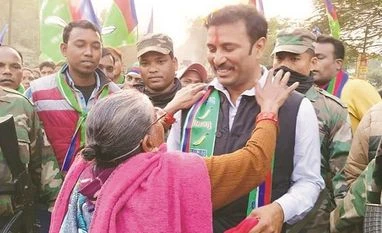
Sudesh Mahto
Mahto fought and won his first election in 2000 when Jharkhand was formed.
Radhika Ramaseshan
6 min read Last Updated : Dec 15 2019 | 9:51 PM IST
Some would imagine it was either foolhardy or brave of Sudesh Mahto to jump into the Jharkhand battle-ground alone, without his old ally, the Bharatiya Janata Party (BJP), to handhold. Mahto, who heads the All Jharkhand Students Union (AJSU), lost the Ranchi Lok Sabha election in 2014. And in 2018, he was trounced in a by-poll by a Jharkhand Mukti Morcha (JMM) greenhorn from Silli, his former borough in Ranchi district.

His close AJSU aides would not confirm but Ranchi’s political chatter had it that Mahto decided to discard the BJP the day the Maharashtra and Haryana election outcomes became known. Neither augured well for the BJP although it emerged as the single-largest party in these states. The BJP looked vulnerable to Mahto when, after riding the crest of a “pro-incumbency” wave since 2014 (with an occasional reversal), it capitulated before a significantly smaller party in Haryana and resorted to questionable means to set up a government in Mumbai.  

“His ambitions were stirred. He fancies himself as another Uddhav Thackeray although Jharkhand isn’t Maharashtra and there’s no Sharad Pawar here,” a political observer in Ranchi said. The BJP reportedly offered Mahto 11 of the 81 seats — three more than what he got in 2014 — but he refused, believing that playing the kingmaker or preferably the king was a better strategy in 2019. However, his best shot could be out of range because Mahto will have to first wrest Silli from Seema Devi.

Ambition dressed in platitudes, such as “Ab ki baar, gaon ki sarkar (This time, a government of the village)” cannot conceal Mahto’s agenda. As his Royal Enfield Bullet, with AJSU Spokesman Deosharan Bhagat as his pillion passenger, shot through the streets of Silli, his cheerleaders hammed the familiar lines: “Jharkhand ka mukhya mantri kaisa ho, Sudesh Mahto jaisa ho (How should Jharkhand’s CM be? Of course, like Sudesh Mahto)” to drumbeats. Six months ago, 45-year-old Mahto took to IT and social media earnestly, went big on Facebook and Twitter, and set up call centres at several villages, attended to by his workers to address and redress local problems. His rallies and roadshows are broadcast real-time on social media by tech-savvy supporters, culled from training institutes.

A Mahto confidant listed three attributes as his “strengths”. “He’s been a minister in governments since 2000 but there isn’t a whiff of a scam around him. He has enormous administrative experience and is accessible to his workers and people in general,” he claimed. However, the “Hindalco ghost” apparently haunted Mahto. In April 2019, a serious breach in the retaining wall of the Muri refinery plant on the banks of the Swarnarekha river at Lagam village in Silli released a toxic flood of red mud that killed one worker and injured half a dozen others. The plant suspended operations, leaving several persons jobless. Mahto belongs to Lagam and tells the electorate that a vote for him alone will ensure that the refinery restarts and their jobs return.  

There was no denying that Mahto pumped up the AJSU organisation into top gear, making the ingenious “chulha pramukh (literally gas fire chief)” the nucleus of the structure. A riff on the BJP’s “panna pramukh (page chief)”, the chulha pramukh’s role transcended booth management. They are not party functionaries but men and women drawn from villages to purvey the message that politics was not about possessing wealth and resources or bearing a famous name but belonged to the “aam (common)” folk. They are expected to forge a long-term commitment to the AJSU that will not end with one election. Dada, as Mahto is known, is a first-generation politician who shuns the regulation white kurta-pyjama and wears jeans, casual shirts and sports shoes. 

A fitness freak, he jogs regardless of electioneering, is a football player and set up an archery academy in Silla named after Birsa Munda, Jharkhand’s freedom fighter and folk legend. Since the AJSU, founded on June 22, 1986, was underpinned on the demand for a separate tribal state and set store by Jharkhand’s identity, Mahto kept its history alive as the first politician who raised the statues of Birsa Munda and Bipin Bihari Mahto, Koylanchal’s social activist.

Mahto fought and won his first election in 2000 when Jharkhand was formed. At 25, he was made a minister in the BJP-helmed government of Babulal Marandi and became deputy chief minister in the 2009 coalition government. “He was never far from power,” remarked a political observer. While his propensity to strike compromises and stay in the system was seen by some as diluting the AJSU’s founding ideals that repudiated conventional politics, others believed it was just as well that Mahto was pragmatic. 

What now? A return to the BJP if Jharkhand gets a hung Assembly or a search for new allies? Political sources said Mahto’s equation with the BJP’s incumbent CM, Raghubar Das, was “indifferent”. On his part, Amit Shah, the BJP president and Union home minister, publicly stated that he would always welcome back Mahto. So who knows what the future holds?
 
The party has a history of violence
 
The AJSU was founded by Nirmal Mahto with the support of Prabhakar Tirkey and Suraj Singh Besra on June 22, 1986. The founders wanted militant agitations and were initially active in the Santhal Pargana region. Nirmal Mahto wanted AJSU workers to be trained in guerrilla warfare tactics and sent Besra, Harishanker Mahto and Bablu Murmu to Assam and the Gorkha hills. Mahto’s career was cut short in 1987 when he was murdered in Jamshedpur.

However, the AJSU persisted with agitations. To make its voice for a separate Jharkhand heard in Delhi, in 1989, it targeted railway tracks — its activists tried to blow up trains on the Mumbai-Howrah line. Buta Singh, the then home minister, invited AJSU leaders for talks after which the AJSU softened its stand. It boycotted the 1989 General Election but had the first shot in electoral politics in the 1990 Bihar elections in which two of its nominees, Besra and Suraj Singh, were elected. They fought on the Jharkhand Mukti Morcha symbol but later split. Besra quit to fight for a separate state.

Sudesh Mahto was active in the AJSU since 1991, but came into his own after Jharkhand was formed in 2000 and there was no looking back since then.
 

One subscription. Two world-class reads.

Already subscribed? Log in

Subscribe to read the full story →
*Subscribe to Business Standard digital and get complimentary access to The New York Times

Smart Quarterly

₹900

3 Months

₹300/Month

SAVE 25%

Smart Essential

₹2,700

1 Year

₹225/Month

SAVE 46%
*Complimentary New York Times access for the 2nd year will be given after 12 months

Super Saver

₹3,900

2 Years

₹162/Month

Subscribe

Renews automatically, cancel anytime

Here’s what’s included in our digital subscription plans

Exclusive premium stories online

  • Over 30 premium stories daily, handpicked by our editors

Complimentary Access to The New York Times

  • News, Games, Cooking, Audio, Wirecutter & The Athletic

Business Standard Epaper

  • Digital replica of our daily newspaper — with options to read, save, and share

Curated Newsletters

  • Insights on markets, finance, politics, tech, and more delivered to your inbox

Market Analysis & Investment Insights

  • In-depth market analysis & insights with access to The Smart Investor

Archives

  • Repository of articles and publications dating back to 1997

Ad-free Reading

  • Uninterrupted reading experience with no advertisements

Seamless Access Across All Devices

  • Access Business Standard across devices — mobile, tablet, or PC, via web or app

Topics :JharkhandJharkhand Mukti MorchaBJPBharatiya Janata PartyUddhav ThackeraySharad PawarRadhika Ramaseshan

Next Story



