As politics meets soap opera in UP, Samajwadi Party feels the strain

The ongoing drama in SP has the potential to tilt the loyalty of voters in the state
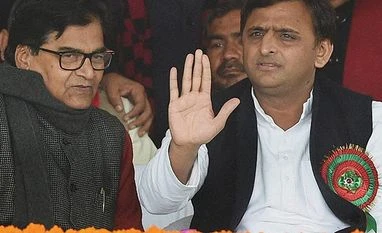
Uttar Pradesh Chief Minister Akhilesh Yadav with expelled SP leader Ram Gopal Yadav. Photo: PTI
Virendra Singh Rawat
Last Updated : Jan 07 2017 | 11:35 PM IST
The infighting within the Yadav clan, which controls the Samajwadi Party, has all the ingredients of a soap opera: suspense, envy, ambition and histrionics. It is a clash of generations as much as it is about the internal politics of a powerful family where the rules of succession have not been neatly laid down. Such are the daily twists and turns that friend and foe alike are unable to plan their next move. 

On January 1, the power struggle claimed its biggest casualty thus far when patriarch Mulayam Singh Yadav was removed as the party’s national president, though he was made the margdrashak. In his place, his son, Akhilesh, the chief minister of Uttar Pradesh, was handed over the reins of the party which is a force to reckon with in Uttar Pradesh.

The unthinkable had happened. In poll-bound Uttar Pradesh, it was inconceivable for Samjawadi Party to join the fray without Mulayam. Maybe Akhilesh reckoned that his septuagenarian father could no longer attract youth votes. 

Maybe he felt the work done by his government (Lucknow Metro, Lucknow-Agra Highway) would overshadow Mulayam’s appeal. Akhilesh, all this while, showed no explicit displeasure towards his father — the image of the loving son whose hand had been forced by conniving relatives never really shed him.

Whatever be his calculations, the sudden development came at the special convention called by the Akhilesh faction after Mulayam had sided with the rival faction led by his younger brother, Shivpal, and trusted aide and Rajya Sabha Member of Parliament Amar Singh.

While team Akhilesh has blamed the Amar-Shivpal combination for conspiring against him in a bid to scuttle his chances of returning to power in the polls, Mulayam has always sworn for their loyalties towards him and the party. But the lawmakers have, by and large, sided with Akhilesh, putting Mulayam in a spot — he has lost control of the party he founded and nurtured.

Now, the two factions are slugging it out at the doorsteps of the Election Commission. Each has claimed to be the “real” Samajwadi Party and has staked its claim over the popular party symbol of bicycle. While Amar Singh and Shivpal have been blamed for all the trouble, which many feel will benefit the party’s adversaries in the coming elections, some people have pointed to the tacit role played by Mulayam’s wife, Sadhna Gupta, her son Prateek and daughter-in-law, Aparna, for the feud within the party that will complete 25 years of its existence later this year. 

A growing rift

Sadhna is Mulayam’s second wife. Akhilesh’s mother, Malti Devi, died in 2003.It is widely believed that Sadhna has for long demanded a share in the party’s political power, which has all along been stiffly opposed by Akhilesh and his aides.Last year, Akhilesh’s aide and legislator Udayveer Singh had written a terse letter to Mulayam cautioning him of vested interests around him for the mistrust brewing in the party, although he did not explicitly name anyone. 

He was later sacked from the party by Mulayam, yet he continues to enjoy Akhilesh’s full confidence. Mulayam was instrumental in anointing Akhilesh as the chief minister after the 2012 polls, even in the face of opposition within the party and family. Akhilesh’s wife, Dimple, is an MP from Kannauj. 

In this context, Prateek and Aparna have not yet been bequeathed any political power, even as several of Mulayam’s extended family members, including brothers, cousins and nephews, hold high political offices in Parliament, Uttar Pradesh Legislature Assembly, blocks and panchayats. 

Even though Prateek has always stayed away from the glare of the media and has never expressed the desire for a political role for himself, Aparna has gradually made a mark for herself in public life through her social service initiatives, especially in the fields of women empowerment and sanitation. These, many say, were her baby steps towards a full-fledged 
political career later.

Prateek and Aparna, the daughter of a senior journalist who is now an information commissioner in Uttar Pradesh, had tied the knot in 2011 after courtship. The couple has a daughter, Prathma, who was born in 2013. They also studied together in the UK. 

She is a classical and folk singer too and performs at cultural fests. She speaks her mind, sometimes digressing from the official Samajwadi Party line. In the past, she even candidly praised Prime Minister Narendra Modi and slammed personalities who had raised the issue of growing intolerance in the society to target him.

While Prateek’s fitness and property businesses keep him busy, Aparna’s candidature for the impending polls from the Lucknow Cantonment constituency was announced by Mulayam last year. The seat is currently held by Rita Bahuguna Joshi, who had recently switched sides from the Congress to the Bharatiya Janata Party.

Interestingly, Aparna’s name was missing from the list of probable candidates released by Akhilesh, which amply indicated his unwillingness to allow Aparna any power play under him.

Political watchers believe Sadhna has been siding with Shivpal to keep Akhilesh under check, since they both realise the hard fact that a powerful Akhilesh in the future would put them on the sidelines permanently, especially after Mulayam, 77, ceases to be active politically and otherwise. The two half-brothers, Akhilesh and Prateek, share a formal relationship and have conspicuously maintained their distance in public and avoid commenting on each other.

No senior Samajwadi Party leader or Yadav family member has ever spoken on this contentious issue and much of the rift between Akhilesh and Sadhna still remains in the realm of speculation. The sequential events strongly buttress this fact nonetheless.

Differences  come out in the open

Although the trouble within the party and the ruling family was never a secret, the cracks had started to emerge at regular intervals.

On September 8, 2015, at an official function in Lucknow, Shivpal, who was then holding the public works and irrigation departments, had publicly alleged that some bureaucrats attached with departments headed by Akhilesh had been causing hurdles in the projects of his departments and not heeding his directives.

Coming from the most powerful minister in the Akhilesh cabinet, this washing of dirty linen in the open indicated matters were on the boil. On other occasions, Mulayam publicly chided Akhilesh and warned him against his coterie of officials and ministers.

On September 12, Akhilesh sacked two key cabinet ministers, Gayatri Prasad Prajapati and Raj Kishore Singh, and followed it up by removing chief secretary Deepak Singhal. 

The three were considered close to Mulayam and Shipval. In later months, the two factions had their respective show of strength during Akhilesh’s ‘Vikas Rath Yatra’ and the party’s silver jubilee celebrations in Lucknow. The spat escalated when Shivpal and his three trusted ministers were sacked from the council of ministers. 

The four have still not been reinstated by Akhilesh, despite Mulayam’s advice to this effect.Matters took a turn for the worse when Mulayam and Shivpal started to declare candidates for the elections, and Akhilesh, feeling sidetracked, responded by declaring his own list of candidates.

As Akhilesh was unrelenting, Mulayam sacked Akhilesh and Ram Gopal Yadav, his cousin who had decided to side with the chief minister, from the party for six years, although the decision was reversed within 24 hours at the intervention of senior party leader Azam Khan.

The feud has dented the image of the party and, many believe, has shaken the confidence of its core voters, the Yadavs who form 12-15% of the state’s population. It has also created confusion in the minds of the party’s workers.The ‘Vikas Rath Yatra’ of Akhilesh has largely been a non-starter and the few public meetings by the party leaders have been no more than public posturing by the two factions in a bid at one-upmanship.

Several Samajwadi Party leaders fear, and this concern was raised by party’s Muslim face Azam Khan, that Muslim voters may shift loyalty, which will benefit rivals like the BJP. Mayawati, the other contender for power, in order to capitalise on the situation, has fielded a record number of Muslims in the elections. There is also speculation that the Congress may tie up with the Akhilesh faction for the elections, provided he makes a clean break from the old guard. 

While everybody wants to know if the Samjawadi Party will split or not, one thing is certain: this is a soap opera that is not going to end quickly.

One subscription. Two world-class reads.

Already subscribed? Log in

Subscribe to read the full story →
*Subscribe to Business Standard digital and get complimentary access to The New York Times

Smart Quarterly

₹900

3 Months

₹300/Month

SAVE 25%

Smart Essential

₹2,700

1 Year

₹225/Month

SAVE 46%
*Complimentary New York Times access for the 2nd year will be given after 12 months

Super Saver

₹3,900

2 Years

₹162/Month

Subscribe

Renews automatically, cancel anytime

Here’s what’s included in our digital subscription plans

Exclusive premium stories online

  • Over 30 premium stories daily, handpicked by our editors

Complimentary Access to The New York Times

  • News, Games, Cooking, Audio, Wirecutter & The Athletic

Business Standard Epaper

  • Digital replica of our daily newspaper — with options to read, save, and share

Curated Newsletters

  • Insights on markets, finance, politics, tech, and more delivered to your inbox

Market Analysis & Investment Insights

  • In-depth market analysis & insights with access to The Smart Investor

Archives

  • Repository of articles and publications dating back to 1997

Ad-free Reading

  • Uninterrupted reading experience with no advertisements

Seamless Access Across All Devices

  • Access Business Standard across devices — mobile, tablet, or PC, via web or app

Next Story



