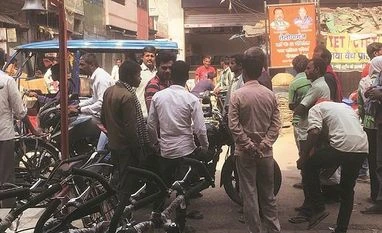
It is past noon at Mirzapur’s Teliaganj labour chowk. Over 100 daily wagers are returning home after not being hired for a day’s work. Ramu Maurya is one of them. He cycles 20 km from his village to the chowk in search of work every day. In the last five years, Maurya has observed that jobs available have reduced, while the number of job-seekers has increased. “Now I find out-of-work carpet weavers, factory workers and women at the Labour Chowk,” he says. “While earlier, I worked for over 20 days in a month, now I’m lucky to find work for 15!” Every day, more than half the daily wagers thronging the chowk return without finding work.
The growing rate of unemployment in Mirzapur, barely 60 km from Varanasi, is palpable not only in the hordes of out-of-work daily wagers here but also can be seen in downed factory shutters, derelict cold storages and lack of any new construction in the city.
The data from the National Sample Survey Office suggests that rate of unemployment in Uttar Pradesh is the fourth highest in the country, up from 1.5 per cent to 6.4 per cent in 2017-18. Blame it on the downswing in the local carpet weaving industry, the impact of GST on small businesses or the slowdown of construction post demonetisation — unemployment is the most visible issues on the ground as Mirzapur gears up for the Lok Sabha election to be held here on May 19.
Faces of unemployment Not far from Maurya, a dozen women also wait for the increasingly elusive labour contractor. Zohra Begum, 60, says she gets work barely five days a month here. “Women are the last to be picked by contractors, unless the task is of breaking stones, a traditionally feminine task,” she says. Sometimes, she works as an agricultural labourer. “Before the 2014 election, Modiji came to Mirzapur and promised that soon we’ll see smoke coming out of old factory chimneys,” says Birendra Maurya, another daily wager. “Instead, in the last few years, even the existing factories have shut down. All their workers come to the labour chowk now, desperate for jobs…”
Slowdown in local businesses Jobseekers in Mirzapur cite the slowdown in local businesses as one of the main reasons for growing unemployment. The carpet industry, the largest local employer, is in downswing. Most metalwork units have shut down. So have two of the three large cold storages in the city. “Earlier, there was ample work to be found in construction,” says Awadhnath Chamar, a mason. “Now GST has made construction materials more expensive and demonetisation has taken out the cash which fueled the industry!”
Flawed implementation of government schemes The impact of Mirzapur’s growing jobs crisis is exacerbated by the flawed implementation of social security schemes. Ramlal, 70, has not received the old-age pension he had applied for about four years ago. “My son, a graduate, has been looking unsuccessfully for a job for one year,” he says. “I’m forced to do manual labour while I wait for my pension and he waits for a job!”
The Swachh Bharat Mission, one of BJP’s key poll issues, has been implemented somewhat patchily on the ground here. “It depends on the pradhan’s whim,” says Amresh Kumar of village Kohari. “Many houses in our village have neither toilets nor water,” he says. “We have to fetch it from the village well for household use.” The Pradhan Mantri Awas Yojana, implemented in over 36,000 eligible households across Mirzapur, has also not impressed everyone. “In my village, they constructed four walls and a roof, but left out doors and windows,” alleges Arif Ansari. “What’s the use of such houses?”
Still caste and religion matter
“Jobs, flawed implementation of social welfare schemes and farmer distress are urgent issues but people here are too canny to believe in campaign promises!” says Shiva Kumar Upadhyaya, a senior local journalist. “Over decades, they’ve voted different political parties to power but their situation has remained relatively unchanged.” This is why many believe that at the end of the day, voting in Mirzapur could still be driven by the good old primal forces of Indian politics — caste and religion.
The incumbent Anupriya Patel of Apna Dal (Sonelal) is backed by her own caste, the politically significant Kurmis. By allying with the NDA, she also has support among the upper castes, traditional BJP strongholds. In Jiuti village, Rahul Pathak is ensuring his family votes for her. “At the end of the day, upper castes must show their support for the Apna Dal and the BJP,” he says. Muslims and lower castes are also said to be grouping similarly to vote for Rajendra S Bind (Samajwadi Party). Lalitesh Pati Tripathi, great grandson of former UP chief minister Kamalapati Tripathi, is making inroads among tribals. “Caste and religion are likely to remain important in the upcoming elections,” says Upadhyaya.

 "Demonetisation, GST: Mirzapur's slowdown in local biz leads to joblessness")









