GST compensation row: State govts ask Centre to borrow and pay

The finance ministry on Saturday officially communicated the finer details of the two options to states to make up for the compensation shortfall by way of borrowings
gst meet, gst
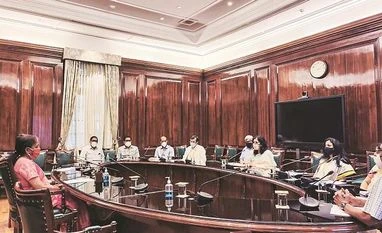
Union Finance Minister Nirmala Sitharaman during an interaction with directors and deputy secretaries of the Department of Expenditure and Ministry of Finance
Dilasha Seth New Delhi
4 min read Last Updated : Sep 01 2020 | 12:53 AM IST
Terming the two options proposed by the Union government as “unconstitutional,” “illegal” and “a betrayal of the spirit of cooperative federalism,” key opposition-ruled states pressed the Centre to borrow in order to compensate states for the entire goods and services tax (GST) shortfall ‘regardless of Act of God’.

While six states – Kerala, Telangana, Chhattisgarh, Delhi, Punjab and West Bengal – huddled over a video-conference meeting on Monday to thrash out a strategy to take on the Union government, some states separately shot off letters to the Centre, expressing disapproval of putting the onus of borrowings on states.

Tamil Nadu chief minister Edappadi K Palaniswami wrote to Prime Minister Narendra Modi, arguing that the Centre had a moral and legal obligation to compensate states for the GST shortfall.

Meanwhile, Punjab and Chhattisgarh chief ministers wrote to Union finance minister Nirmala Sitharaman, contesting the growth assumptions and the concept of bifurcating revenue loss figures into Covid and non-Covid.

The finance ministry on Saturday officially communicated the finer details of the two options to states to make up for the compensation shortfall by way of borrowings. 
 
The first option is to only borrow up to Rs 97,000 crore which is a shortfall arising out of GST implementation via a special window by the Reserve Bank of India. The other option is the entire Rs 2.35 trillion, which accounts for the Covid-19 situation through the issue of market debt.

Punjab finance minister Manpreet Singh Badal pegged the total revenue loss at Rs 4.5 trillion till the end of the compensation period, which he argued, will require more than 4-5 years to repay rather than 2-3 years that is being believed.

“We take both the options with great regret as a clear breach of the solemn and constitutional assurance by the central government. We believe this is betrayal of the spirit of cooperative federalism that formed the backbone of the GST journey so far,” said the letter.

Badal contested the Centre’s estimation of GST-loss, assuming a 10 per cent growth and attributing the rest to the pandemic. “This makes the whole exercise of calculating losses arbitrary, one sided and devoid of any legal justification. GST revenues were growing at about 4 per cent in the pre-Covid year 2019-20. The GDP growth in 2019-20, Q4 in particular, had also significantly slowed down. We believe that applying a rate of growth of 10 per cent to project a higher revenue loss due to Covid-19 is over-simplistic, statistically incorrect, besides being legally unsound,” Badal added.

Chhattisgarh highlighted that the GST shortfall is not entirely on account of Act of God and that Chhattisgarh faces 35-40 per cent shortfall. The loss on account of Covid is not more than 20 per cent. “The shortfall is not an “Act of God” as the Central government is suggesting. There is a 38-40 per cent shortfall annually in Chhattisgarh,” the state finance minister said on Monday.

Kerala finance minister Thomas Isaac, who was part of the opposition-ruled state finance ministers’ meeting, pointed out that it was decided that the central government must borrow the entire compensation, “regardless of Act of God, humans or natural, to be paid back by extending the period of cess,” he said.

Chhattisgarh finance minister T S Singh Deo tweeted that, “it was agreed among states that the Centre should make good the shortfall and most importantly only move through consensus in the GST Council instead of trying to push its agenda.”

Tamil Nadu CM, wrote in his letter to Modi, said that borrowing from the market by states will be administratively difficult to implement and more expensive. 

West Bengal finance minister Amit Mitra also rejected both options and had said on Sunday, “In the name of Act of God, a huge debt is thrust on states. States finances will lose its health and that will lead to crushing federalism.”

Punjab sought constitution of a group of ministers (GoM) to deliberate on the matter and make recommendations in a time-bound period of 10 days.

One subscription. Two world-class reads.

Already subscribed? Log in

Subscribe to read the full story →
*Subscribe to Business Standard digital and get complimentary access to The New York Times

Smart Quarterly

₹900

3 Months

₹300/Month

SAVE 25%

Smart Essential

₹2,700

1 Year

₹225/Month

SAVE 46%
*Complimentary New York Times access for the 2nd year will be given after 12 months

Super Saver

₹3,900

2 Years

₹162/Month

Subscribe

Renews automatically, cancel anytime

Here’s what’s included in our digital subscription plans

Exclusive premium stories online

  • Over 30 premium stories daily, handpicked by our editors

Complimentary Access to The New York Times

  • News, Games, Cooking, Audio, Wirecutter & The Athletic

Business Standard Epaper

  • Digital replica of our daily newspaper — with options to read, save, and share

Curated Newsletters

  • Insights on markets, finance, politics, tech, and more delivered to your inbox

Market Analysis & Investment Insights

  • In-depth market analysis & insights with access to The Smart Investor

Archives

  • Repository of articles and publications dating back to 1997

Ad-free Reading

  • Uninterrupted reading experience with no advertisements

Seamless Access Across All Devices

  • Access Business Standard across devices — mobile, tablet, or PC, via web or app

Topics :goods and service taxGST collectionGST compensation

Next Story



