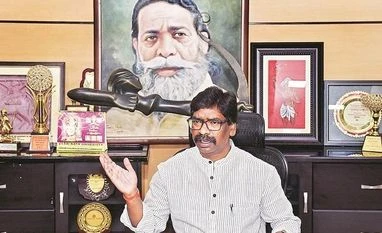
An inheritor does not necessarily have it easy. If he’s the legatee of a weighty political party, the passage to power is that much more challenging because he has to earn and justify the mighty endowment — by leading and winning elections, coaxing workers’ fealty and that done, by retaining power. Since Jharkhand was created in 2000, its politics has been murky. Hemant Soren, the scion of Shibu Soren (Guruji to his followers) — who principally catalysed and shaped Jharkhand’s politics — has still to come out of his father’s shadow, although Shibu’s political career was itself riddled with controversies and reverses.
At 44, Hemant is positioned to go for the gold in the Jharkhand election because he was declared chief ministerial candidate by the mahagathbandhan (grand alliance), led by his party, the Jharkhand Mukti Morcha (JMM), with the Congress and the Rashtriya Janata Dal (RJD) as the principal components. The alliance is pitted against the Bharatiya Janata Party (BJP), the All Jharkhand Students Union (AJSU), and the Jharkhand Vikas Morcha (Prajatantrik). What does the responsibility bode for Hemant?
“The burden of expectations is huge. Guruji’s politics was about carving out a new state. Hemant has to sustain Guruji’s spirit by delivering a victory and if that’s achieved, making a mark in governance,” said a JMM adviser.
Supriyo Bhattacharya, the JMM’s general secretary, claimed Hemant’s “credibility, hard work, transparent functioning and a commitment to carry forward his father’s legacy” were qualities that should not be “brushed aside” when sizing up his potential. “Sometimes, people get confused because (Narendra) Modi had built a perception that he’s the only person who mattered and everyone else was inconsequential (in Jharkhand),” said Bhattacharya.
Regardless of Prime Minister Modi’s discourse against the JMM, there was a near-consensus in the state that Hemant’s previous stints in office — as deputy chief minister from September 2010 to January 2013 in the BJP-helmed Arjun Munda government and as chief minister from July 2013 to December 2014 in a JMM-Congress-RJD coalition dispensation — weren’t exactly “inspiring”.
In 2013, Shibu rated his son’s fledgeling government as “average”. When journalists sought Hemant’s reaction to his father’s swipe, he said: “What do you suggest I do? Fight with Baba?” Hemant’s supporters underplayed the episode as a “fallout of the alliance arrangement”. Political watchers felt Hemant’s time and energy were spent on “balancing the egos” of his partners and the Independents because the short-lived tenure was marked by interminable bickering over administrative postings. The Congress blocked Hemant’s pet project of framing guidelines on Jharkhand’s vexatious domicile policy.
On completing 100 days as CM, he told an interviewer that he was not a magician like P C Sorcar and admitted to being assailed by allies’ pulls and pressures. “Sau sonar ki, ek lohar ki (a hundred blows of a goldsmith are equal to one blow of an ironsmith)” was his answer to a question.
JMM sources said Hemant had hoped to find his metier as the Opposition leader in the Assembly from 2014. “He grew up seeing Guruji fight for the people, adivasis and non-adivasis alike. When in 2016 the BJP government tried to tamper with the Chhota Nagpur and the Santhal Pargana tenancy Acts (that protected adivasi land and properties against incursions), he agitated big time. When the CM (Raghubar Das) invited Hemant to a global investors’ summit (in 2017), he turned it down, calling it a grand jamboree of land grabbers,” a functionary said.
Following the JMM’s rout in the Lok Sabha polls, Hemant focused on regenerating the party’s organisation and reinvigorating the cadre. “He thought investing in these was the only way to make the party sustainable. The JMM is unique in that even today — its workers carry bows and arrows (the official symbol), although you see young persons with iPads and smartphones. Campaigning is done through door-to-door visits,” an adviser said.
In these elections, Hemant did half a dozen public meetings a day and spent evenings talking to the villagers in groups of 30 and 40. “He talked with them instead of talking down to them,” emphasised a JMM source. He painstakingly confined himself to raising only local issues, telling voters that while the Balakot strike had lived its life in the Lok Sabha polls, it was time to take on the BJP on his terrain. On the Citizenship Amendment Act, Hemant made it a point to tell the people of the Santhal Pargana, which has a large Bengali-speaking migrant population, that if he was voted to power, he would not implement the Act before a “thorough” review.
Rajkumar Jha, a retired political science professor from Ranchi, believed that although Hemant was “guided or misguided by a coterie that’s not known for its integrity”, his strengths were that he was young, was the “only tribal leader with a future”, and had a “large following among those who benefitted from his largesse when he was in power”. Enough to make him a strong contender for the top job?
JMM: From the Left to the Right and the centre
The Jharkhand Mukti Morcha (JMM), which summed up its constitution as the “liberation of Jharkhand”, was founded in 1973 by Binod Bihari Mahto, Shibu Soren, A K Roy, Nirmal Mahto, and Tek Lal Mahto. The JMM was an offshoot of the Sonat Santhali Samaj, which was set up in 1969 by Shibu Soren to find a political voice for the tribes of undivided Bihar. However, in its original conception, the JMM was a more inclusive party of the tribes, the backward castes, Dalits and Muslims.
It was not before 1995 that the JMM and the demand for Jharkhand were taken note of by the central government. That year, the Jharkhand Area Autonomous Council was set up — regarded as the first step towards the carving out a separate state.
On July 22, 1997, the Bihar Assembly adopted a resolution to create a separate state but under duress, because the JMM was supporting the Lalu Prasad regime. In 1998, when Lalu reversed his stand, the JMM pulled out. Finally, in 2000, the Vajpayee government, which was committed to creating smaller states, cleared the Bill for Jharkhand’s inception with Chhattisgarh and Uttarakhand.
The JMM has aligned with the political spectrum, from the Left to the Right and the centre in the pursuit of power. It is headed by Shibu and his son, Hemant Soren. The party is control-led by the Sorens; six other family members are part of the central committee.