Ministries take to Hindi, nominate nodal officers to oversee cleanliness
MEA is not the only ministry to now consciously use Hindi in official work
Archis MohanSanjeeb Mukherjee In a first, the ministry of external affairs (MEA), strongest bastion of the English language atop Raisina Hill, on Wednesday issued its set of official orders in Hindi, besides English. Plus, the MEA and all other ministries nominated nodal officers from among their staff to oversee cleanliness in the premises of ministries and departments, another first.
The drive towards cleaner office spaces would also include discouraging office staff and visitors from smoking or spitting on the building premises. Nodal officers have been entrusted with checking whether the office space has adequate number of dustbins and whether they are cleaned routinely, corridors should be cleared of junk such as old almirahs or not-in-use files. Nodal officers have also been asked to ensure safety alarms are functional, cleaning and mopping is done twice a day, office spaces are suitably lit, and the area outside the rooms of senior officials is kept clean.
As for the increased use of Hindi, MEA officials couldn’t remember the previous occasion the ministry had issued its transfer/posting circulars in any language other than English.
MEA is not the only ministry to now consciously use Hindi in official work. Now, officials in the Department of Agriculture and Food have been directed to prepare notes, files and other important correspondence in Hindi along with English. When he took charge, Agriculture Minister Radha Mohan Singh instructed his officials to prepare their notes on the working of the ministry in Hindi. As the sudden change in work culture caught officers unawares, many rushed to locate a translator.
Similarly, several senior Indian Foreign Service (IFS) officials have scurried to brush their Hindi language skills. There is an increased demand for ‘English to Hindi’ dictionaries. An IFS (B) officer, who hails from North India, said respect has increased for those IFS officers and clerical staff who are proficient in Hindi. “Officers who can quickly translate English documents into ‘official’ Hindi have become much sought after,” the official added.
Officials of some other ministries, particularly those where ministers from the Hindi heartland are at the helm, say their ministers have requested them to put up name plates outside their offices in Hindi, or at least both in English and Hindi. This move towards Hindi is also apparent at the Press Information Bureau briefings. During the United Progressive Alliance (UPA) years, the name plates were mostly only in English. The names of ministers who brief the press are now exclusively in Hindi.
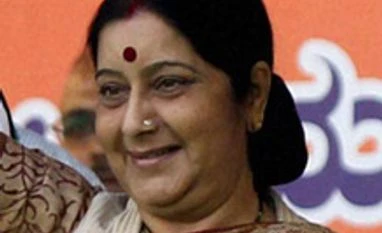
Many in the council of ministers such as foreign minister Sushma Swaraj, who are otherwise fluent speakers of English, have taken to speaking only in Hindi at official events and meetings.
According to sources, Swaraj spoke mostly in Hindi with her Chinese counterpart Wang Yi during their three-hour long discussion on Sunday. An official said Swaraj would only occasionally use English words. Chinese Foreign Minister Wang is also a fluent speaker of English but rarely speaks in that language during bilateral meetings. Swaraj was following the example of Prime Minister Narendra Modi. He had spoken in Hindi to all the visiting heads of state and government who attended his oath taking ceremony, as also to those who phoned to congratulate him.
In its latest June 15 issue, Sangh Parivar mouthpiece Panchjanya lauded members of Parliament who took their oaths in the Lok Sabha in Hindi, Sanskrit and regional languages. In its editorial, Panchjanya editor Hitesh Shankar said this reflected the new government’s first message of “restoring the pride in Bharatiyata”.
The editorial recalled how Atal Behari Vajpayee as the external affairs minister in the Janata Party government of 1977 spoke in Hindi at the United Nations General Assembly session. It said the current government was “only the second instance” in the history of Independent India where “the government at the Centre stood with pride to accord respect to Hindi”.
Shankar complimented Modi for indicating that he would speak in Hindi during bilateral meetings with foreign leaders. “This is the voice of those who studied in government-run schools, people who despite their talent and commitment were considered second-class,” Shankar said. He added that Samajwadi Party chief Mulayam Singh Yadav, another advocate of lesser use of English, would support the effort.

 "Ministries take to Hindi, nominate nodal officers to oversee cleanliness")


