Modi govt blames Congress for stalling triple talaq Bill in Parliament

However, Ghulam Nabi Azad said government intended to keep the pot simmering on the issue to malign his party
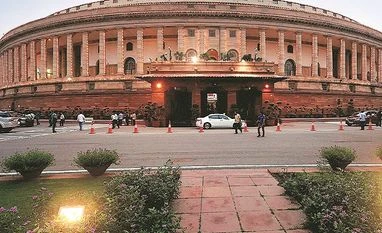
Modi govt blames Congress for stalling triple talaq Bill in Parliament
Finance Minister Arun Jaitley invited suggestions from political parties to make electoral funding more transparent
Archis Mohan New Delhi
Last Updated : Jan 06 2018 | 2:47 AM IST
The winter session of Parliament, one of the shortest in recent times, came to an end on Friday, without the Rajya Sabha passing the triple talaq Bill. The Narendra Modi government blamed the Congress for stalling the contentious Bill, but asked the party to support it in the forthcoming Budget session. The government ruled out bringing an ordinance.

Parliamentary Affairs Minister Ananth Kumar said the Cabinet Committee on Parliamentary Affairs held its meeting on Friday and recommended to the President to convene the Budget session from January 29. He said the Budget session will start with the President’s address to the joint sitting of the two Houses on January 29, and the Union Budget will be presented on February 1. Parliament will break for recess from February 10 to March 4, to allow standing committees to study budgetary allocations. The second part of the Budget session is scheduled from March 5 to April 6. The Budget session will have 31 sittings. Kumar said the Modi government was committed to legislating the triple talaq Bill. Government sources said an ordinance on the issue was ruled out now that the dates for the next session have been announced. “The Congress showed double standards on the issue in the two Houses. There is considerable anger in the country on the Congress approach,” the minister said.


The minister said the productivity of the Lok Sabha was 91.58 per cent, and of the Rajya Sabha, whose proceedings were marred by the deadlock over Prime Minister Narendra Modi’s comments about predecessor Manmohan Singh during the Gujarat election campaign, was 56.29 per cent. He said 22 Bills were passed during the winter session, 13 by the Lok Sabha and 9 by the Rajya Sabha. However, Congress leader Ghulam Nabi Azad said the government intended to keep the pot simmering on the issue to malign his party. Azad said Law Minister Ravi Shankar Prasad, with whom he had a long meeting some days ago, has refused to understand that the triple talaq Bill in its present shape was faulty. “It demonises Muslim men, and would become an instrument to send them to jail,” Azad said, pointing out several inconsistencies in the Bill, particularly its “draconian” penal provisions.

Kumar said those who had predicted that the winter session would be a washout have been proved wrong. Not just the triple talaq Bill, the government would also bring the Bill to give statutory status to the National Commission for Backward Castes in the Budget session.

Azad and Congress Lok Sabha member Deepinder Hooda said the government was responsible for the impasse in the Rajya Sabha. Hooda said the Modi government wants to use Parliament as a “rubber stamp” and has unleashed an “ordinance raj”. Hooda said seven ordinances were issued each year during the duration of the 13th and 14th Lok Sabhas, which decreased to 5 ordinances a year during the 15th Lok Sabha. 

He said 10 ordinances have been issued each year during the ongoing 16th Lok Sabha. Similarly, lesser number of Bills are being referred for better scrutiny to Parliamentary standing committee.

According to the Congress, 65 per cent Bills were referred to standing committees during the 13th Lok Sabha, 60 per cent during the 14th and 71 per cent during the 15th Lok Sabhas. However, only 27 per cent Bills are being referred to the standing committees in the ongoing 16th Lok Sabha. Hooda said the government didn’t agree to demands from the Opposition to have discussions on the alleged irregularities in the Rafale fighter jet deal and agrarian crisis. “The BJP government is undermining Parliament and pushing the country towards dictatorship,” Hooda said.

One subscription. Two world-class reads.

Already subscribed? Log in

Subscribe to read the full story →
*Subscribe to Business Standard digital and get complimentary access to The New York Times

Smart Quarterly

₹900

3 Months

₹300/Month

SAVE 25%

Smart Essential

₹2,700

1 Year

₹225/Month

SAVE 46%
*Complimentary New York Times access for the 2nd year will be given after 12 months

Super Saver

₹3,900

2 Years

₹162/Month

Subscribe

Renews automatically, cancel anytime

Here’s what’s included in our digital subscription plans

Exclusive premium stories online

  • Over 30 premium stories daily, handpicked by our editors

Complimentary Access to The New York Times

  • News, Games, Cooking, Audio, Wirecutter & The Athletic

Business Standard Epaper

  • Digital replica of our daily newspaper — with options to read, save, and share

Curated Newsletters

  • Insights on markets, finance, politics, tech, and more delivered to your inbox

Market Analysis & Investment Insights

  • In-depth market analysis & insights with access to The Smart Investor

Archives

  • Repository of articles and publications dating back to 1997

Ad-free Reading

  • Uninterrupted reading experience with no advertisements

Seamless Access Across All Devices

  • Access Business Standard across devices — mobile, tablet, or PC, via web or app

Next Story



