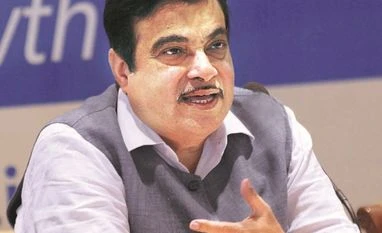
Why does speculation persist that Nitin Gadkari, Union minister for road transport & highways, shipping and water resources, river development & Ganga rejuvenation, could be the one to replace Narendra Modi as prime minister, if the BJP’s tally in the 2019 Lok Sabha election is low? He has denied this time and again, but every now and then a tweet or statement surfaces that is attributed to him and casts the leadership in a poor light. The latest is a supposed observation by him that the top party and government leaders should take responsibility for the state election debacle.
He probably has not said it but this much is true: Gadkari is well-liked and popular both among those in the BJP and those outside. He once said he sees himself as someone who acts as a facilitator in making things happen. For Gadkari, the glass is never half empty, but always half full.
Originally from Nagpur, where the Rashtriya Swayamsevak Sangh has its headquarters, Gadkari has been the leader of the Opposition in the Maharashtra Vidhan Parishad (Upper House). He’s not known for his vote-catching abilities in the state, though he won the 2014 Lok Sabha elections from Nagpur, defeating the Congress’s Vilas Muttemwar by a huge margin. The BJP previously had won from Nagpur only once in 1996, when Banwarilal Purohit defeated Kunda Vijaykar of the Congress, the daughter of former BCCI President S K Wankhede. Purohit originally belonged to the Congress and had earlier won on the ticket of that party. In the 2014 state polls, the BJP won all the six Assembly seats in Nagpur, with one going to Devendra Fadnavis, now chief minister.
Gadkari began life as a small-time contractor for the Public Works Department (PWD), prospered and later set up several companies. While building roads in tribal areas of Maharashtra, he saw how the tribals lived and confessed to having a secret affection for Naxalites. His experience with the government at the time was not great and that shaped his worldview: If you’re a bureaucrat and he’s a minister, you risk saying ‘no’ to him at your peril — because he knows from personal experience how obstructive, as well as malleable, the bureaucracy can be, and doesn’t baulk at abusing uncooperative bureaucrats in fairly basic language.
His career as a contractor and businessman saw him foray into the complex world of cooperatives in the Vidarbha region of Maharashtra, traditionally short of capital, which is why the cooperative experiment never took off there. But Gadkari did start cooperatives in this region. He is the chairman of a group of companies called Poorti, which is into construction and furniture and retail supermarkets.
In 1995, after a career spent pretty much confined to the Vidhan Parishad, Gadkari became minister in the Public Works Department. He did some good work — creating a scientific methodology of BOT (build–operate–transfer) projects by initiating traffic surveys, working out IRR (internal rate of return) and deciding the concession period of toll. He made the Government of Maharashtra change the existing rules and formulated a new toll policy amid scepticism and outrage.
His election to the Upper House unopposed in 2002 was cause for heartburn. He was proud of the fact that he had many friends in the Opposition, including various Thackeray factions and Congress leader, the late Vilasrao Deshmukh. But a section of the Maharashtra BJP felt he had compromised himself politically. They said he showed a marked lack of enthusiasm for going for the government’s jugular when the opportunity arose. They also said this was why no one opposed him in 2002. Be that as it may, the fact is Gadkari has come to be regarded as a politician who understands issues of the interface of development and politics.

 "Newsmaker: Meet Nitin Gadkari, a facilitator in making things happen")












