PM won't quit over Rahul's remarks, questions timing
Says he's not upset, will decide on convicted lawmakers ordinance after consultations
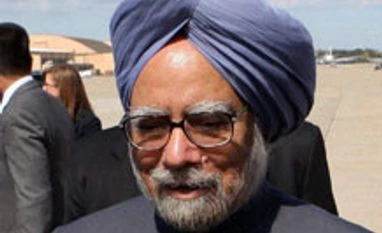
Mihir S Sharma On board Air India One Prime Minister Manmohan Singh said on Tuesday there was no question of his resigning, in spite of Congress Vice-President Rahul Gandhi’s attack on the government’s decision to promulgate an ordinance to prevent convicted legislators’ disqualification. However, he did say he would return to New Delhi and investigate the reasons underlying the attack’s timing. Gandhi addressed a combative press conference when Singh was out of the country, leading to concerns that he had undermined the PM’s authority before important bilateral meetings.
Singh denied that he felt undermined, adding that any member of the party or the Cabinet was able to demand the reconsideration of policy, even one discussed by the party’s core group and twice by the Cabinet. “That is what democracy is about. I don’t think we are an authoritarian structure, where one person lays down the line.”
Singh was less sanguine about the fact that Gandhi spoke out while the PM was on an important overseas visit. Singh said, “I am not the master of what people say. It has happened... When I go back I will try to find out the reasons why it had to be done that way.” He added that he was “used to ups and downs”, and no longer got upset easily. He also said he would discuss the future of the ordinance with Rahul Gandhi and the Cabinet on his return. After his consultations, he said, “we will see which way the wind blows” on the ordinance.
Singh also launched an unprecedented, direct assault on the Gujarat chief minister and the prime ministerial candidate of the BJP.
He said all secular forces must combine to face the “onslaught of people like Narendra Modi”. He advised reporters, on Modi, that “you wait for some time before the people realise what they are up against”.
The PM laid out a minimalist agenda for the remainder of his government’s tenure. “In whatever time is left,” he said, he would see that “the country is better managed” in order to restore growth and control inflation; that the borders were kept secure; and that the “people-oriented programmes” of the UPA were properly implemented.
Speaking about his trip to the United States, in which he dealt with a business climate markedly more hostile to India than previously, the PM said the concerns in the Indo-US economic relationship were caused essentially by the Indian growth slowdown. “When the Indian economy was growing at 8 to 9 per cent, I think everybody was quite happy. Even when there were defects in our policies, they were overlooked; when the economy slows down, people try to find fault and excuses." In spite of hectic lobbying in the US, the PM confirmed that President Obama did not go into detail about American complaints, and instead said the matter should be taken forward by the CEOs' forums on both sides in order to “find the meeting ground”.
Singh emphasised the paradigmatic shift in defence cooperation with the US from a “buyer-seller” to a “co-production and co-research” model. The US’s desired outcome on defence cooperation, he said, was “in line with our own thinking”.
About his meeting with Pakistan PM Nawaz Sharif, Singh echoed his National Security Advisor Shivshankar Menon’s description of it two days previously as “useful” and a step towards normalising relations and restoring “tranquillity” on the Line of Control. Sharif, he said, had “said all the right things” about Indo-Pakistan relations, and the PM said he “hoped and prayed he [Sharif] succeeded”. Singh also said that he told Bangladesh PM Sheikh Hasina that he was himself disappointed that ratifying an already signed border agreement with Bangladesh had taken “much too long”, and that the government would, as a priority once Parliament reopened, convince the “problem” opposition parties to fall in line.
ON THE PM’S TO-DO LIST TODAY * To meet Congress Vice-President Rahul Gandhi to discuss the ordinance on convicted lawmakers
* To attend a meeting of the Congress Core Group to discuss the matter
* To meet President Pranab Mukherjee ahead of the Cabinet meeting when the controversial ordinance is expected to be withdrawn
* To preside over the Cabinet after meeting the President, who is said to have reservations over the move to provide immunity to MPs and MLAs from immediate disqualification by overriding a Supreme Court judgment on the issue
IN THE PM’S WORDS “I am not the master of what people say... I will try to find the reason why it happened that way”
“...when the economy slows down, people try to find faults and excuses”
“I sincerely hope all secular forces will combine to face the onslaught of people like Narendra Modi”
“We may have done some wrongs but we did a lot of good things… People of the country will take that into account while voting”

 "PM won't quit over Rahul's remarks, questions timing")


 Connect with us on WhatsApp