
Statsguru: Where flagship welfare schemes of Modi govt stand after 7 years
Business Standard looks at eight key schemes of this government
 "Statsguru: Where flagship welfare schemes of Modi govt stand after 7 years")
premium
WebinarsNew
Deep DiveNew
Explore Business Standard
Business Standard looks at eight key schemes of this government
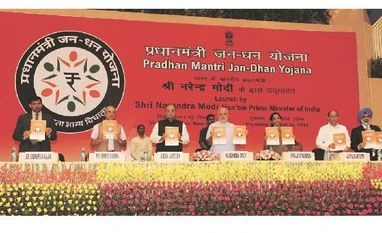
Pradhan Mantri Jan Dhan Yojana (PMJDY), the financial inclusion scheme introduced by the Narendra Modi government, completed seven years in August. So have some other schemes, such as the Namami Gange Project (NGP) and Swachh Bharat Mission (SBM). Some of the recent schemes are picking up pace, while some have achieved their targets. Business Standard looks at eight key schemes of this government (chart 1).
Namami Gange was the first grand project announced by Prime Minister Narendra Modi after coming to power in 2014. It consisted of sewage and effluent treatment work, river cleaning, afforestation, and biodiversity conservation along the Ganga. After seven years, 132 of the 315 sanctioned projects have been completed, and Rs 9,066 crore from the sanctioned amount of Rs 28,854 crore was spent by July 2021 (chart 2).
PMJDY has seen 430 million bank accounts being opened in seven years, and the average deposit size has grown from Rs 800 in December 2014 to Rs 3,366 in August 2021 (chart 3). Swachh Bharat Mission, which revamped the Nirmal Bharat Abhiyan, succeeded in providing private toilets to all homes in the country in 2019-20 (chart 4).
Pradhan Mantri Awas Yojana not just matched, but did better than the original Indira Awas Yojana in providing all-weather houses to rural folk. At its peak, as many as 4.5 million houses were built in 2018-19 (chart 5). PM Ujjwala Yojana provided free LPG connections to 80 million households in four years. But the usage among beneficiaries has been poor — nearly half of them not refilling cylinders in a year (chart 6).
Under the Pradhan Mantri Jan Aarogya Yojana, only half the intended amount of Rs 6,400 crore was spent for two successive years. Spending did not meet the Budget estimate despite the fact that Covid-19 increased the general hospitalisation rate in the country (chart 7).
The government came up with the first large-scale cash transfer scheme in 2019, Pradhan Mantri Kisan Sammaan Nidhi (PM-KISAN). The scheme has reached 91 per cent of intended beneficiaries in three years (chart 8). About 100 million farmers receive regular cash payments of Rs 6,000 from the government thrice a year.
Drinking water to rural homes has been a priority of previous governments too, but the Jal Jeevan Mission has increased the rate of tap provision. Yet, about 62 per cent rural homes do not have access to drinking tap water (chart 9).
Already subscribed? Log in
Subscribe to read the full story →

3 Months
₹300/Month
1 Year
₹225/Month
2 Years
₹162/Month
Renews automatically, cancel anytime

Over 30 premium stories daily, handpicked by our editors


News, Games, Cooking, Audio, Wirecutter & The Athletic
Digital replica of our daily newspaper — with options to read, save, and share


Insights on markets, finance, politics, tech, and more delivered to your inbox
In-depth market analysis & insights with access to The Smart Investor


Repository of articles and publications dating back to 1997
Uninterrupted reading experience with no advertisements


Access Business Standard across devices — mobile, tablet, or PC, via web or app
First Published: Sep 05 2021 | 1:42 PM IST


