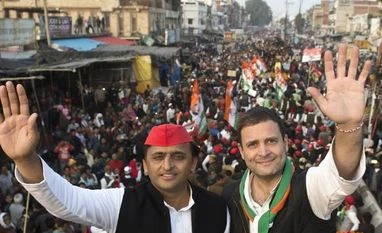
Among the five states going to polls, Uttar Pradesh is seen as the most exciting battleground this year. With 403 Assembly seats, the state is a big political arena that wields its muscle in central power equations, too. In the run-up to the seven-phase UP Assembly elections that begin February 11, there is enough to keep pollsters and election pundits busy. From the likelihood of a hung Assembly after the Congress party deciding to hitch a ride on the Samajwadi Party’s (SP’s) bicycle to the Bharatiya Janata Party emerging as the single-largest party and Mayawati’s underdog Bahujan Samaj Party (BSP) waiting to spring a surprise – there’s every ingredient to make the state election a perfect potboiler.
However, another rabbit waiting to jump out of the hat in this election could be the much-understated ‘Nota’, when seen in combination with independent candidates and registered (unrecognised) parties.
Before the SP-Congress alliance, some reports suggested BJP and BSP could be the strongest contenders, thanks to an infighting within SP’s Yadav family. But now, the fight seems to have become a three-cornered one – BJP, BSP and SP-Congress combine, all look strong on paper. You cannot write off any; that seems to remind you of the 1990s and early 2000s, except that the ‘None of the above’, or Nota, could heavily skew political equations now, unlike in the earlier decades. In previous Uttar Pradesh Assembly elections, we have seen independents (Ind) and registered (unrecognised) parties (RPs) together cornering decent vote shares. Will those two, along with the debutant Nota – it was started in the 2014 general elections to allow voters to reject all candidates in fray on any seat and is being used in the UP state polls for the first time – prove a game-changer?
Let us first look at the role of ‘Ind’ + ‘RP’ in previous UP assembly polls to understand why they matter.
The rise of Ind + RP vote share
After the fall of BJP’s first majority government in the state, it took 16 years to form another one. Thanks to the rise of other parties in the mid-90s —SP and BSP — parallel to the BJP. But, there was more to it. On parallel, the combined vote shares of Ind and RP were also rising gradually.
The Ind+RP combined vote share, 8.39 per cent in 1993 (except SP, which was then an RP), rose to 12.15 per cent in 1996, and further to as much as 20.01 per in 2002. In 1993, the Ind+RP vote share, when combined with the Janata Dal’s (JD’s) 12.33 per cent, was enough to damage the political equations and start a new era of unstable government formations. In 1996, the vote shares of Ind+RP, BSP and SP grew at the expense of the Congress and the JD, so no party was able to form a government on its own. The only similarity between 1993 and 1996 Assembly elections (and in 1991 before that) was BJP’s vote share of 33.3 per cent and 32.53 per cent (31.45% in 1991), respectively.
In 2002, the Ind+RP vote share zoomed to 20.01 per cent from 12.15 per cent in 1996, contributing to the formation of another khichdi government.
This was the period when the three major parties of the present time were rising simultaneously. BJP saw a major erosion in its vote base in 2002 Assembly elections – from 35.52 per cent in 1996 to 20.08 per cent.
Majority and Ind+RP
In 2007, the Mayawati-led BSP formed a majority government on its own, with a 30.43 per cent vote share. SP was the second-largest party with a share of 25.43 per cent votes. In 2012, in a role reversal of sorts, SP formed the majority government with a 29.13 per cent vote share and BSP came second with a vote share of 25.91 cent. In both elections, BJP’s vote share was in mid-teens — 16.97 per cent in 2007 and 15 per cent in 2012. Therefore, as data suggest, both elections predominantly became two-way contests.
Though the vote share of Ind+RP in the two subsequent elections was way less than in 2002, it was significant enough – at 13.34 per cent and 14.39 per cent in 2007 and 2012, respectively.
The trends for vote share in the past few elections seem to suggest that the votes polled by the Ind-RP combine dents the chances of a stable government formation whenever there are more than two potential contenders. But, when there are only two major contenders, Ind-RP seems to help the bigger party in forming the government comfortably.
Enter the Nota
Though Nota votes are not taken into account for calculating the total valid votes, it still takes away a small part of total votes polled from parties’ equations. In the 2014 Lok Sabha polls, the Nota share was 1.08 per cent. In other recent Assembly polls in large states like Maharashtra, Bihar, Assam, Kerala, Tamil Nadu and West Bengal, the shares of Nota were 0.91 per cent, 2.48 per cent, 1.1 per cent, 0.5 per cent, 1.3 per cent and 1.5 per cent, respectively. Except Maharashtra, which couldn't form a single-party government, the states that have gone to polls in recent times have seen two-way contests. Combined with Ind+RP vote share, Nota could swell the basket —it has varied from 0.5 per cent to 2.48 per cent in different states, displaying the potential to upset political equations.
Hung Assembly
Approached by Business Standard for her take, Sudha Pai, professor at the Centre for Political Studies, Jawaharlal Nehru University, said that Nota+Ind+RP affect parties in the UP elections was statistically possible. But, she added, it could affect all parties similarly.
Eminent Sociologist Dipankar Gupta said independents and fringe parties were things of the past. In the current elections, there was a strong consolidation of all such sections into major parties.
In the recent past, some small parties have merged into BJP, the most prominent of them being the Anupriya Patel-led faction of the Apna Dal. Another popular example is the Mukhtar Ansari-led Quami Ekta Dal’s merger with BSP.
If that holds true, it might be hard to guess the extent of erosion in the Ind+RP votes. If the erosion is small, Nota will be enough to offset the loss from Ind+RP votes as the data indicate.
On hung Assembly, Pai also said: “I think that is a possibility.” Though she didn’t link Nota+Ind+RP vote share with a hung Assembly, she said: “There are three very strong groups against on another... I don’t think we can write off Mayawati.” Akhilesh might make a lot of it, but his party’s alliance with the Congress came a bit too late, she added.
Gupta also agreed that there was the chance of a hung Assembly. He further opined that a few factors like Mayawati’s aggressive campaign to woo Muslims and the Rashtriya Lok Dal’s presence in western UP could upset calculations on some seats. But, he added, the SP-Congress combine still had the advantage, as most Muslims were likely to vote for an alliance.
Experts agree that if all the three parties run aggressive campaigns, there is a significant chance of a nail-biting contest. The final outcome of the state elections would then be left to the contests for a few dozen seats where the gap between the winner and the loser might be of a few hundred votes. This is where, at least numerically on the basis of past data, the Nota+Ind+RP vote share could play its role. As historical data show, the emergence of such a scenario has always led to unstable governments. So, could Nota+Ind+RP votes alter the course of the UP elections? We will know the answers on March 11.