The 'battle of the ballots' in Uttar Pradesh is, again likely to be settled through an interplay of polarisation and counter-polarisation of votes. Major political parties and alliances' high and uncanny claims of securing comfortable majority in the Assembly polls is unlikely to make much difference.
Even as all parties are claiming to be seeking votes on the issue of development, the dynamics of caste, religion and community are radically intertwined in their political messages and electoral strategies.
The major political parties and alliance -- Bharatiya Janata Party (BJP), Bahujan Samaj Party (BSP) and Samajwadi Party-Congress -- have all been claiming to secure over 300 seats in the polls during election rallies and press interactions.
Both BSP and SP-Congress have been vigourously and passionately appealing to the minorities for votes to keep the "communal" BJP at bay, while claiming to be the real champions of their rights.
The premium placed on the minorities votes can be understood from the simple fact that BSP and SP-Congress combine have allotted almost 25 per cent of the party tickets to Muslims although the community comprises 18 per cent of the state population.
The minorities are acknowledged as a significant voting bloc in elections, especially in the light of the perception of the community voting en bloc for any particular party or alliance, which is likened to be in a better position to stall the BJP.
The minorities voters have over the years shifted from Congress to SP. BSP also enjoys its share of popularity amongst the more marginalised sections of Muslims.
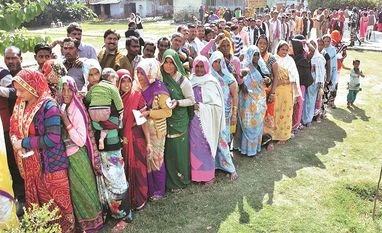
In this poll, the two parties and alliance are hoping to get a major chunk of the minorities votes, while holding on to their traditional vote banks. They have been deliberately trying to rake emotional and community-based issues and incidents to warn the community against BJP with a view to consolidate this chunk in their favour.
Apart form fielding 100 Muslim candidates for 403 Assembly seats, BSP has also inducted mafia done-turned-politician Mukhtar Ansari and his kin to the party to further underline its pro-minority stance. It may be recalled that BSP Chief Mayawati had in the past expelled the Ansaris from the party.
Ansari, his son Abbas and elder brother and former MP Afzal Ansari are contesting as BSP candidates. They enjoy considerable clout, especially amongst Muslims, in several Assembly constituencies in eastern UP districts of Ghazipur, Mau, Varanasi etc.
In her speeches, Mayawati has been cautioning Muslims against voting for SP-Congress claiming SP was a divided house after the long raging power feud within the ruling Yadav family, while Congress was a non-existent entity in UP. She maintains the division of minorities vote would only benefit BJP.
On the other hand, SP leaders have been alleging BSP could possibly ally with BJP post election to form the next state government as a tactic to confuse the Muslim voters. So much so that Mayawati had to refute this allegation terming it as a conspiracy to queer BSP's pitch in the poll due to its better poll performance so far.
Meanwhile, BJP has not fielded any Muslim candidate and its leaders have been vocal in claiming the party treated people as equal without any discrimination on basis of religion and caste.
It is believe the high octane pursuance of the minorities votes by BSP and SP-Congress have the potential to infuse the dynamics of counter-polarisation of Hindu votes, which would help BJP at the hustings. Besides, division of the minorities votes would also brighten up its poll performance.
On its part, BJP has raised controversial issues like 'triple talaq', Hindu migration from western UP towns, illegal abattoirs etc to subtly appeal to the traditional and middle-class voters in the state. These have also found mention in its UP election manifesto.




